


 Play store

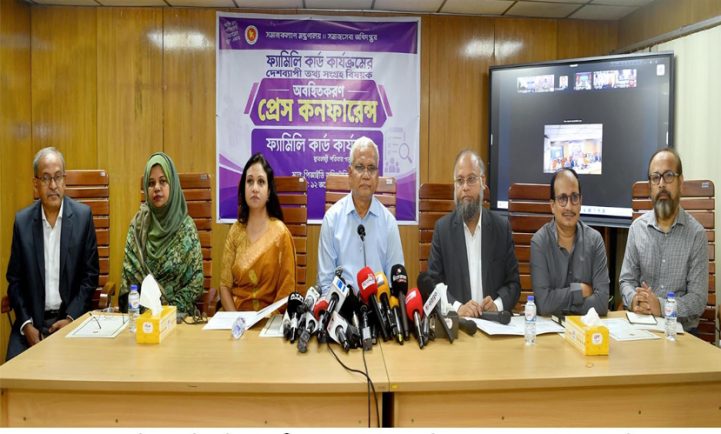
The government has launched a nationwide household data collection drive to build a database for its Family Card programme, targeting the inclusion of an estimated 44.5 million households by December.
Social Welfare Minister Professor Dr AZM Zahid Hossain announced the initiative at a press conference at the Secretariat on Monday. State Minister for Social Welfare Farzana Sharmin was also present.
The programme aims to empower women and strengthen their rights, dignity and economic independence by issuing Family Cards in the names of female heads of households, the minister said.
Prime Minister Tarique Rahman launched the pilot phase of the programme in Dhaka on March 10. By June 2026, information had been collected from 112,094 households across 57 units in 55 upazilas and city corporation areas in 44 districts across all eight divisions.
Of these, 71,831 eligible beneficiaries were selected based on the Proxy Means Test (PMT) score and provided with Family Cards and allowances.
The pilot programme had an allocation of Tk 866 million, of which Tk 657.3 million was spent, including Tk 572 million in allowances, the minister said.
Full-scale implementation began in July, with Tk 14,500 crore allocated for the programme in the 2026-27 fiscal year. Of the total allocation, Tk 12,300 crore has been earmarked for allowances.
The government has formulated the Family Card Implementation Policy 2026 to ensure the programme’s effective rollout.
Under the updated PMT system developed by the Bangladesh Bureau of Statistics (BBS), households will be classified into five socioeconomic groups: extremely poor, poor, vulnerable lower-income, middle-income and upper-income.
Women heading households with a PMT score of 860 or below will be considered eligible for allowances. While all female heads of households will receive Family Cards, cash benefits will initially be provided to those in the first three groups, representing households with comparatively lower PMT scores.
The nationwide data collection drive began on Monday. A total of 66,815 enumerators and 6,681 supervisors have been deployed for the exercise, with the first phase of staff training completed.
Enumerators will visit households and collect information in person using specialised tablets connected to mobile networks. The data will be uploaded directly to an online database.
The government has also completed necessary preparations involving mobile SIM cards, network-based cybersecurity, staff management and the establishment of a Network Operations Centre to support the operation.
The target of 44.5 million households is based on an estimate of five members per household, the minister said. Eligible beneficiaries will subsequently be selected from the database using the PMT system.
The government aims to provide Family Cards and allowances to an additional four million female heads of households during the current fiscal year. All eligible female household heads are expected to be brought under the programme over the following three fiscal years in phases.
The cards will feature dual chips, QR codes and near-field communication (NFC) technology and will be linked to the government’s person-to-person payment system.
Beneficiaries will be able to withdraw their allowances through bank ATMs, point-of-sale terminals at retail outlets and mobile financial services, the minister said.
Social Welfare Ministry Secretary Dr Mohammad Abu Yusuf, Department of Social Services Director General Shah Mohammad Mahbub, Chief Information Officer of the Press Information Department Syed Abdal Ahmed and senior ministry officials also attended the press conference.