Play store

Bangladesh witnessed the beginning of an extraordinary movement on the very first day of July 2024—one that ultimately led to the fall of the long-ruling Awami League (AL) government.
What began as a student-led protest demanding reform of the quota system in government jobs soon transformed into the Anti-Discrimination Student Movement and later evolved into what became widely known as the July Uprising.
At the outset, few imagined that a movement centred on recruitment quotas would grow into a nationwide student-mass uprising that would eventually bring an end to nearly 16 years of AL rule.
The renewed protests were triggered after a High Court order declared invalid the government’s 2018 circular that had abolished quotas in the recruitment of first- and second-class government officers.
The 2018 decision itself had come after large-scale student demonstrations, during which protesters faced violent attacks allegedly carried out by activists of Bangladesh Chhatra League, the student wing of the ruling party.
Student anger resurfaced when the court ruling effectively restored the quota structure, including 30 percent for descendants of freedom fighters, 10 percent for women, 10 percent for residents of underdeveloped districts, 5 percent for minority communities, and 1 percent for persons with disabilities.
Many students viewed the restored system as unfair to merit-based recruitment and quickly returned to the streets demanding change.
As the demonstrations expanded, tensions escalated. The government’s hardline response—through security operations and confrontations involving pro-government activists—turned the movement into a broader uprising. According to figures cited by protest supporters, at least 834 people were killed and around 20,000 injured, making it one of the deadliest episodes of political unrest in Bangladesh since independence.
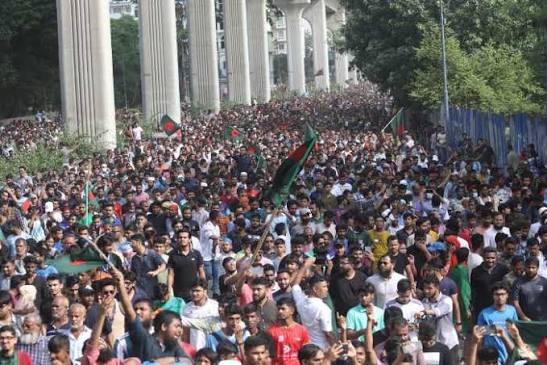
The crackdown on largely unarmed protesters intensified public anger and widened participation far beyond students. What had started as a policy protest gradually turned into a national movement against authoritarian governance.
Despite repeated efforts to retain power, the government ultimately failed to contain the growing resistance.
On August 5, amid mounting public pressure and mass demonstrations, Prime Minister Sheikh Hasina resigned and left the country for India, marking the end of Awami League’s nearly 16-year rule that began in 2008.
Her departure stood in contrast to earlier public remarks in which she had insisted that she would not flee. Yet within days, overwhelming public mobilisation—including huge marches toward Dhaka despite curfew restrictions and heavy rain—changed the political landscape.
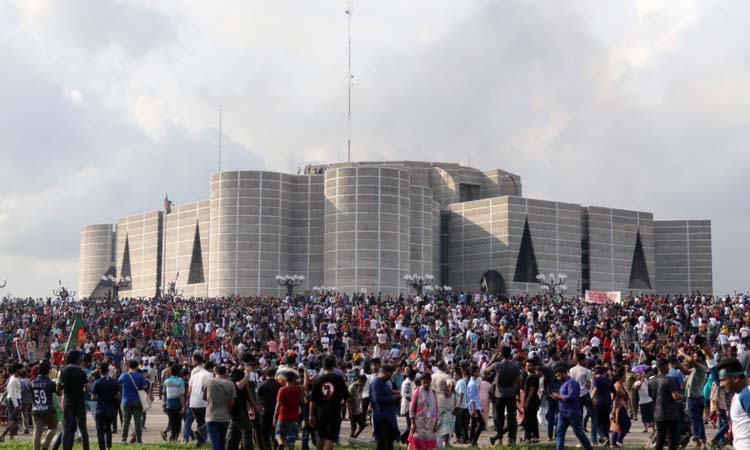
Following her departure, large crowds across the country celebrated what many participants described as the end of an era and the beginning of a new political chapter for Bangladesh.