


 Play store

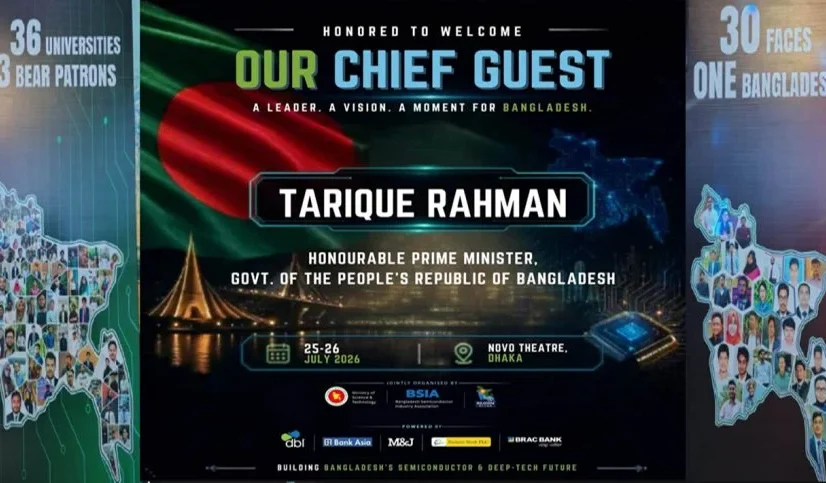
Bangladesh on Saturday launched the two-day National Semiconductor Symposium and BEAR Summit 2026, unveiling an ambitious vision to build a $150 billion deep-tech economy by 2035 through investments in semiconductors, biotechnology, electronics, artificial intelligence (AI) and robotics.
Prime Minister Tarique Rahman is set to inaugurate the summit at the Bangabandhu Sheikh Mujibur Rahman Novo Theatre in Dhaka, where policymakers, global technology leaders, researchers, entrepreneurs and students have gathered to discuss the country’s long-term strategy for developing a globally competitive semiconductor and advanced technology industry.
The summit is jointly organized by the Bangladesh Semiconductor Industry Association (BSIA), the Ministry of Science and Technology and Silicon River Bangladesh.
Among those attending the inaugural session are Science and Technology Minister Fakir Mahbub Anam Swapan, ICT Adviser Rehan Asad, BSIA President M.A. Jabbar and Science and Technology Secretary M. Anwar Hossain.
The keynote address will be delivered by Prof. Muhammad Mustafa Hussain of Purdue University, who is leading efforts to formulate Bangladesh’s long-term semiconductor and deep-tech strategy.
Prof. Hussain outlined an ambitious roadmap to transform Bangladesh into a global innovation hub capable of generating $150 billion in annual revenue by 2035 through the growth of semiconductor manufacturing and other advanced technology industries.
Emphasizing the country’s demographic advantage, he said Bangladesh’s 65 million young people have the potential to become global leaders in semiconductors, biotechnology, electronics, AI and robotics if they receive the right education, training and long-term policy support.
Drawing inspiration from Silicon Valley, he said major technological revolutions are often driven by relatively small groups of highly creative innovators. He expressed confidence that Bangladesh could build a similar innovation ecosystem through its “Silicon River Bangladesh” initiative.
This year’s summit features 93 BEAR Patrons selected from 36 universities, alongside 36 young representatives from One Bangladesh. Organizers described them as the future leaders of the country’s technology sector who will help drive innovation in deep-tech industries.
The conference has attracted senior executives from the global semiconductor industry, academics, investors, startup founders, university representatives and Bangladeshi technology professionals working abroad.
Ahead of the summit, a lightning talk session was held on Friday at United International University (UIU), featuring Beach-Yen Thi Tran, Chairman of VSPA, and Jayavel Pachamuthu, Distinguished Engineer for Technology Development at Sandisk.
Other prominent speakers participating in the summit include Dr. Ahmed Bahai, Chief Technology Officer of Texas Instruments; Dr. Dimitrios Peroulis, Senior Vice President of Purdue University Online; former Applied Materials Vice President Anisul Khan; Credo Associate Vice President Shatil Haque; Prof. Terry Lynn Alford of Arizona State University; Syed Badruddoza, R&D Director at NXP Semiconductors; and M. Ziaul Karim, Chief Technology Officer at YES.
According to the organizers, the event is being livestreamed through the official Facebook pages of BEAR 2026 Bangladesh and the Bangladesh Semiconductor Industry Association, enabling audiences worldwide to follow discussions on Bangladesh’s emerging deep-tech ecosystem.
The summit is expected to strengthen collaboration among government, academia and industry while helping position Bangladesh as an emerging destination for semiconductor manufacturing, research and innovation in the global technology landscape.