Play store

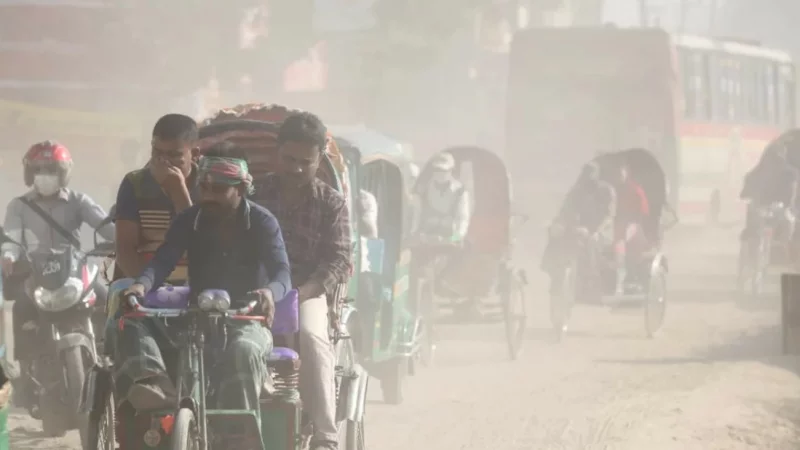
Bangladesh’s capital, Dhaka, ranked seventh among cities with the worst air quality in the world on Tuesday morning, recording an Air Quality Index (AQI) score of 119, according to global air quality monitoring data.
At 9:00 am, Dhaka’s AQI fell into the “unhealthy for sensitive groups” category, indicating that children, older adults and people with respiratory or heart conditions may experience adverse health effects from prolonged exposure to polluted air.
According to the latest AQI rankings, Jakarta, Indonesia, topped the list with a score of 170, followed by Kinshasa, Democratic Republic of the Congo with 169, and Lahore, Pakistan with 167.
An AQI reading between 101 and 150 is considered “unhealthy for sensitive groups,” while a score between 151 and 200 is classified as “unhealthy.” Readings of 201 to 300 are deemed “very unhealthy,” and values above 301 are considered “hazardous,” posing serious health risks to the entire population.
Dhaka has long grappled with severe air pollution, particularly during the dry winter months when dust from construction activities, emissions from vehicles, brick kilns and industrial operations significantly deteriorate air quality.
Although pollution levels typically decline during the monsoon season due to rainfall and stronger winds, the city continues to experience periodic spikes in airborne pollutants.
The AQI is a daily indicator that measures the concentration of major air pollutants and their potential impact on public health. The index is calculated based on five key pollutants: fine particulate matter (PM2.5), coarse particulate matter (PM10), nitrogen dioxide (NO₂), carbon monoxide (CO), sulphur dioxide (SO₂) and ground-level ozone (O₃).
Health experts warn that prolonged exposure to polluted air can increase the risk of respiratory infections, asthma, chronic lung disease, cardiovascular problems and premature death. Children, elderly people and individuals with pre-existing heart or lung diseases are particularly vulnerable to the harmful effects of poor air quality.
They recommend limiting prolonged outdoor activities on days with elevated pollution levels and using protective measures, such as face masks and indoor air filtration, whenever possible.