


 Play store

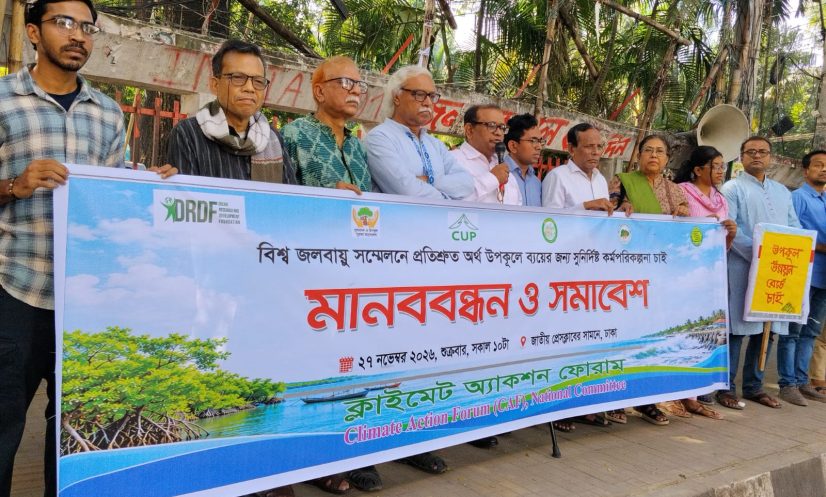
Environmental activists and civil society leaders have called for a clear action plan to utilise the climate finance pledged to Bangladesh at the recently concluded COP31 conference, prioritising the protection of climate-vulnerable coastal areas and improving the livelihoods of their residents.
They also demanded a special allocation for coastal development in the national budget and the formation of a Coastal Development Board to implement an integrated development plan for the region.
The demands were raised at a human chain and rally held in front of the National Press Club on Friday. The event was organised by the Climate Action Forum, Dream Research and Development Foundation (DRDF), Sundarbans and Coastal Protection Movement, Coalition for the Urban Poor (CUP), Environment and Climate Change Movement (PARIZA), Mritytika and Sachetan Sangstha.
The rally was chaired by Climate Action Forum President Aminur Rasul and moderated by Nikhil Chandra Bhadra, coordinator of the Sundarbans and Coastal Protection Movement.
Among those who addressed the gathering were former Communist Party of Bangladesh general secretary Ruhin Hossain Prince, Sher-e-Bangla Agricultural University Assistant Professor and researcher Mir Mohammad Ali, Bangladesh Poribesh Andolon (BAPA) Organising Secretary Mihir Biswas, CUP Executive Director Khondaker Rebeka Sanyat, PARIZA General Secretary Ferdous Ahmed Ujjal, Sachetan Sangstha General Secretary Shakila Parveen, DRDF psychologist and researcher Tanzim Zaman, journalist Samiran Roy, PSDI Foundation Director Ishaq Faruqi and Slum Dwellers Protection Committee President Hosne Ara Begum Rafeza.
Ruhin Hossain Prince said coastal agriculture, biodiversity and people’s livelihoods were increasingly threatened by cyclones, tidal surges, floods, river erosion, land degradation and rising salinity.
The scarcity of safe drinking water, growing livelihood insecurity and displacement were forcing many coastal residents to migrate to cities, he said.
“National development is not possible by leaving the country’s vast coastal region behind,” he said, calling for a long-term, integrated plan to address the climate crisis. He also demanded the publication of detailed information on the amount of money spent so far on tackling climate risks.
Mir Mohammad Ali said Bangladesh had received pledges of special climate finance at COP31, held in Türkiye. However, nearly 67 per cent of the climate finance received by the country so far had come in the form of loans, he said.
He also questioned the lack of transparency regarding the allocation and utilisation of available funds in coastal areas.
“There is no clear allocation, priority list or timeline for the coastal region. Embankments are built, only to be damaged again,” he said.
Alongside efforts to secure a fair share of international climate finance, Bangladesh urgently needed a specific, transparent and accountable action plan for its coastal areas, he added.
Nikhil Chandra Bhadra called for coordinated national initiatives alongside efforts to secure climate justice from the international community. Bangladesh could not rely solely on international conferences to address the climate crisis, he said, urging political parties to adopt a common position on the issue.
In his presidential address, Aminur Rasul said public expectations of the current government were high. He stressed the importance of considering local people’s views and practical needs when designing development projects and ensuring transparency and accountability in their implementation.
He also called for effective measures to protect the Sundarbans and prompt action to honour the commitment to establish a Coastal Development Board.
The rally put forward 11 recommendations to protect coastal communities and ensure climate justice.
The recommendations included earmarking international climate finance for coastal areas and preparing and publishing district-based investment plans with specific implementation timelines. They also called for the sustainable construction and maintenance of vulnerable embankments and adequate cyclone shelters equipped to meet the needs of women, children, older people and persons with disabilities.
The speakers urged the authorities to ensure access to safe drinking water through rainwater harvesting, the re-excavation of ponds and the establishment of water treatment facilities. They also called for climate-resilient livelihood opportunities and incentives for fishers, farmers, forest-dependent communities and women entrepreneurs.
Other recommendations included protecting the Sundarbans and other coastal green belts, making information on climate fund allocations and expenditure publicly available, and introducing social audits at the union level.
The speakers further stressed that local government institutions and community organisations should take the lead in utilising climate funds, with women, young people and marginalised groups actively involved in the planning process.
They also demanded housing, land and employment opportunities for people displaced by climate change. Adaptation and loss-and-damage financing, they said, should be provided in the form of grants, with adequate resources allocated to the Loss and Damage Fund.