Play store

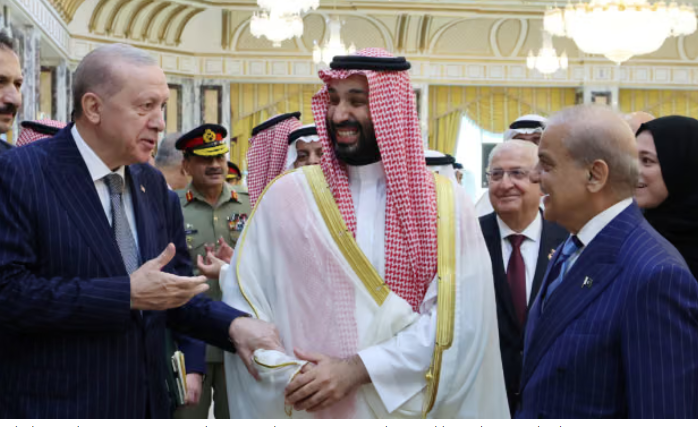
Recently, we saw Saudi Crown Prince Mohammed bin Salman, Turkish President Recep Tayyip Erdogan, and Pakistani Prime Minister Shehbaz Sharif sign the Mecca Joint Defence Agreement, a pact stipulating that an armed attack on any one of the three states would be treated as an attack on all three. Though the agreement is new, there is historical precedent for this new alignment
Turkey and Pakistan were both members of the Central Treaty Organization (CENTO), which came after the Baghdad Pact of 1955. CENTO created a strategic belt bringing together Turkey, Pakistan, Iran, Iraq, and the United Kingdom, effectively stretching from the Middle East into South Asia. The Mecca Agreement, therefore, revives a familiar geopolitical geography with one fundamental difference.
While CENTO was embedded in a Western-initiated Cold War security order, the Mecca agreement is being constructed regionally. In that sense, this agreement is not a resurrected CENTO, but it does have the same strategic logic even if the geopolitical circumstances are different.
In its geography, the Mecca agreement creates the same geography as CENTO did. Turkey forms the western military anchor with NATO’s second-largest standing army and a robust domestic defence industry.
Saudi Arabia, apart from the financial and political heft, forms the Gulf centre, and Pakistan forms the eastern front while bringing the only nuclear arsenal in the Muslim world. Together, the three countries field close to 1.4 million active personnel, thousands of aircraft and tanks, and hundreds of naval assets — a combination no prior Gulf-South Asian arrangement has matched.
The Bangladesh factor
Previously, bilateral agreements, such as the one signed between Pakistan and Saudi Arabia in 2025, played out more like friendship pacts. But the Mecca agreement is explicitly trilateral and structurally resembles a mutual defence treaty rather than a symbolic friendship pact. Importantly, the agreement has been described by its signatories as “open to any brotherly nation that wishes to join.” That open door clause is what transforms it from a regional curiosity to something potentially larger in influence, especially with Bangladesh signalling interest in membership.
And that is what makes it particularly relevant for India, the possibility of the arrangement expanding further east. If Bangladesh were eventually drawn into it, the strategic arc would no longer end in Pakistan but could stretch into the Bay of Bengal and India’s eastern neighbourhood. Though the text of the agreement deliberately names no adversary, it should not be mistaken for innocent ambiguity but rather be seen as each capital having different threats in mind. For instance, Saudi Arabia remains deeply concerned about Iran, while Turkey has an increasingly confrontational relationship with Israel and has a broader ambition that goes beyond its immediate neighbourhood, as reflected in Ankara’s Asia Anew Initiative launched to deepen Turkey’s political, economic, and defence engagement across Asia. And, most obviously, Pakistan continues to position itself against India.
In this context, the pact’s implications for India shifted sharply when Bangladesh’s Foreign Affairs Adviser, Humayun Kabir, said that Dhaka was open to joining the Saudi-Pakistan-Turkey defence framework guided by Bangladesh’s “Bangladesh First” policy. According to reports, Saudi Arabia has since informally invited Bangladesh to join the Mecca pact with Bangladesh Foreign Minister Khalilur Rahman saying, “If they express an intention to include Bangladesh in the pact, we will certainly consider it positively,”.
The concern here isn’t primarily military in the conventional sense. The lesson of 1971, when Pakistan could not sustain military operations in what was then East Pakistan with India in between, still holds.
On the other hand, the real concern here is in the subtler details. Since the fall of Sheikh Hasina’s regime, Bangladesh-Pakistan relations have undergone a security reset. One of the first significant indicators of this growing bond was Dhaka removing the mandatory physical inspection previously imposed on all Pakistani cargo, significantly easing the movement of goods between the two countries.
Direct contacts between Pakistan’s ISI and Bangladesh’s DGFI have also resumed alongside high-level military exchanges, training cooperation, and participation in joint exercises. Bangladesh’s cooperation with Turkey, and not just Pakistan, on weapons systems, drones, and radar suggests that an institutional convergence has emerged. This convergence has layered onto an already strained India-Bangladesh relationship.
In this politically charged environment, if Bangladesh formally joins the Mecca framework, India would naturally face a scenario where a Pakistan-aligned security architecture would sit on its eastern flanks, a problem that New Delhi has spent decades avoiding.
Not a cakewalk for Pakistan
However, the Mecca agreement may not be the gain that Pakistan is imagining it to be. While Pakistan sees prestige, potential arms deals with Turkey, and even a stronger voice in the Middle Eastern security architecture, the joint defence clause means that Islamabad could face expectations to provide intelligence, logistics, ammunition or even military forces if Saudi Arabia or Turkey comes under attack. This would open the fronts that have never been in Pakistan’s security calculus — confrontation involving Iran or Iranian-backed groups, renewed conflict with the Houthis in Yemen or crisis arising from Turkey’s security interests in Syria and the wider Middle East.
The problem for Pakistan is going to be one of strategic overstretch, considering its military already remains heavily oriented toward India while simultaneously dealing with instability and militancy along its western frontier. Moreover, Saudi Arabia and Turkey may now expect Pakistan, particularly because of its large military and nuclear status, to contribute more than symbolic solidarity in a crisis.
The very pact that Pakistan expects to multiply its strategic strength could actually deplete it. Besides, the pact appears unlikely to deliver the one thing Pakistan’s security establishment has historically wanted most: an external backing in a confrontation with India.
For now, the Mecca Joint Defence Agreement remains a work in progress. Its real world triggers and internal commitments have not been tested yet. But India must remain vigilant about the combination of its scope, invitation to new members, and the Bangladesh factor.
Because if Bangladesh joins, an arrangement beginning in the eastern Mediterranean would stretch through the Gulf and Pakistan into the Bay of Bengal, requiring India to now watch not just Islamabad but also Riyadh, Ankara, and Dhaka all at once rather than as separate strategic theatres. This very geography could become the agreement’s weakness.
CENTO demonstrated that placing states with different adversaries, priorities, and threat perceptions beneath a common security umbrella does not automatically produce strategic cohesion. Therefore, for Pakistan, Bangladesh’s inclusion may appear to complete an extraordinary strategic arc around India but the chances are that it could also enlarge a set of military obligations that Islamabad may eventually find difficult to fulfil. Source ThePrint.