Play store

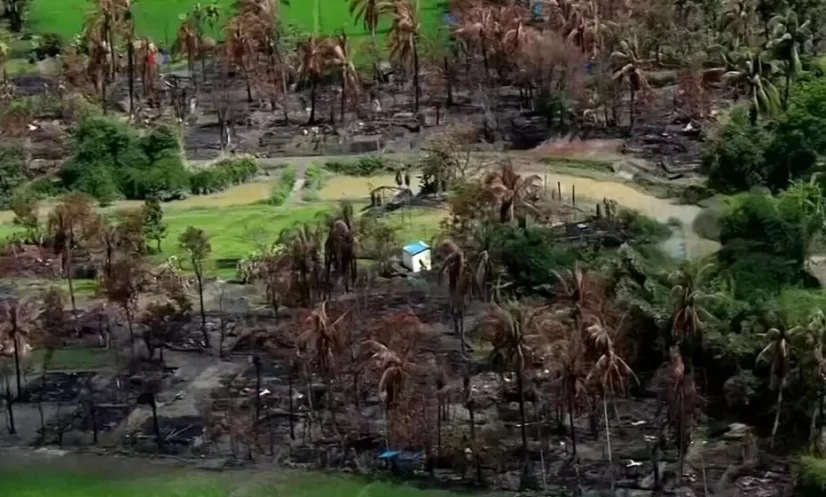
Myanmar’s Arakan Army has built detention camps, military bases and settlements on land belonging to Rohingya communities after taking control of large parts of Rakhine State in 2024, according to an investigation by The Guardian.
The investigation, based on satellite imagery, UN research and testimony from survivors, found that Rohingya villages have been destroyed and their land repurposed for military and detention facilities.
In Hnget Thay, in Buthidaung Township near the Bangladesh border, satellite images show a rice field that was cultivated by Rohingya farmers until 2024. By 2026, around 120 grey buildings had appeared on the site. The investigation identified them as part of a detention camp operated by the Arakan Army, where displaced Rohingya families are reportedly being held. Residents allegedly cannot enter or leave without permission.
The Arakan Army has established at least 10 such camps since taking control of most of northern Rakhine State, according to the investigation.
More than 1.2 million Rohingya are currently living in Bangladesh after fleeing violence and persecution in Myanmar. Mohammad Ares, an 18-year-old Rohingya refugee, said intense fighting broke out in his area after the Arakan Army arrived.
He alleged that the group eventually burned and destroyed his village before forcing displaced residents into camps. “They have turned our homeland into a network of forced-labour camps and military bases,” he said.
In the Wet Nyo Taung area near the Mayu River, Rohingya farmers and boatmen reportedly lost their homes, farmland and fruit orchards when the area was burned in April 2024.
Mohammad Sadiq, 26, said large trees and fruit orchards were cut down and the land was cleared. Survivors said they were forced to demolish their own homes and use the materials to construct facilities for the armed group, including military barracks known as the “AP Battalion.”
Young Rohingya men also alleged that they were forcibly recruited and forced to perform labour, including clearing roads, digging trenches and working inside military camps.
A UN internal report said at least 800 hectares of land belonging to 23 Rohingya villages had been seized since 2024 and used for camps, settlements for other communities or military infrastructure. UN research documented at least 29 incidents involving the seizure of Rohingya land or the displacement of Rohingya communities during the same period.
More than 155,000 Rohingya have fled to Bangladesh since 2024, according to the report. This represents around one-quarter of the estimated 600,000 Rohingya who remained in Myanmar after the military crackdown in 2017.
The Guardian’s investigation and UN reports contain allegations of torture, sexual violence, arbitrary arrests, forced labour, forced recruitment and the collection of “taxes” by the Arakan Army. Similar tactics have previously been used by Myanmar’s military.
One 32-year-old man said he was forcibly recruited and repeatedly beaten during a month in detention. Another person alleged that Arakan Army members abducted his 22-year-old daughter, subjected her to physical and sexual abuse and forced her to undergo military training.
Many residents of the Hnget Thay detention camp are reportedly survivors of the May 2, 2024 massacre in Hoya Siri. Human Rights Watch has documented the deaths or disappearances of more than 170 villagers, including around 90 children.
The Arakan Army has denied allegations of war crimes, saying it targeted only members of Myanmar’s military and Rohingya armed groups.
Nicholas Koumjian, head of the UN’s Independent Investigative Mechanism for Myanmar, said Rohingya appeared to be targeted by all sides involved in the ongoing conflict. However, he said his office had not established evidence conclusively attributing the destruction of Rohingya land to the Arakan Army.
Tom Dannenbaum, a professor of international law at Stanford University, said the alleged coercive measures and efforts to separate Rohingya from their communities could potentially constitute the war crime of population transfer.
Aung Kyaw Moe, until recently the only Rohingya member of Myanmar’s shadow National Unity Government, said the key concern was whether conditions were being created to make the permanent displacement of Rohingya and the erasure of their physical, political and historical presence irreversible.
The International Court of Justice (ICJ), which began hearings in January in the genocide case concerning the Rohingya, has previously considered the systematic expulsion of people and destruction of their homes as potentially relevant to genocide. The court is expected to rule this month on whether the Rohingya were subjected to genocide in 2017.