Play store

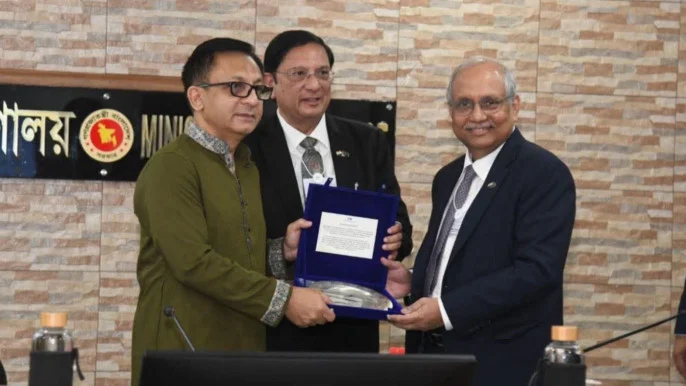
Bangladesh and India should engage in discussions to restore bilateral trade to a normal footing, Commerce Minister Khandakar Abdul Muktadir has said.
He made the remarks at a meeting with a delegation of the Confederation of Indian Industry (CII), led by its Director General Chandrajit Banerjee, at the Secretariat on Tuesday.
The meeting discussed recent trade restrictions, bilateral trade and investment relations, existing challenges and potential areas of future cooperation, according to a press release.
Muktadir expressed hope that positive progress would be achieved within the next few months.
He said the geographical proximity of the two countries offers significant opportunities to turn connectivity into economic benefits through greater trade, investment and industrial cooperation.
Despite differences in size, population and economic strength, Bangladesh and India can benefit from their geographical realities, particularly by expanding trade, connectivity and investment involving Bangladesh and India’s northeastern region, he said.
The minister also stressed the importance of stronger economic connectivity in South Asia. Despite the region’s large combined economy, intra-regional trade remains relatively low, he said, adding that greater economic integration could create opportunities for industrialisation, investment and employment.
The two sides also stressed removing commercial barriers, easing visa procedures and promoting joint initiatives in infrastructure and emerging technologies.
On visa-related difficulties, Muktadir said it was impractical for people who regularly travel for business, medical treatment and other purposes to apply for new visas every few months.
He called for longer-term visa arrangements for regular travellers through greater cooperation between the two countries.
CII proposes joint task forces
The CII delegation proposed forming two joint task forces to strengthen cooperation in infrastructure and high-technology sectors.
One task force would focus on private investment and public-private partnerships in infrastructure, while the other would explore emerging industries such as semiconductors, green hydrogen, battery storage and data centres.
The CII said around Rs 25 lakh crore was invested in India’s infrastructure sector last year, with a significant share coming from the private sector. It suggested that Bangladesh could attract more domestic and foreign institutional investment by drawing on India’s experience.
The meeting also discussed strengthening local manufacturing to reduce import dependence and speed up project implementation.
Indian business representatives said many Bangladeshi enterprises have the capacity to manufacture products locally but have been weakened by various challenges.
Citing a joint initiative with Energypac, a CII representative said Bangladesh continues to import many products despite having domestic manufacturing capacity. Imports through land ports can take 40-45 days, he said, adding that revitalising local industries could reduce such delays.
The CII also expressed interest in investing in Bangladesh’s fast-moving consumer goods sector. It proposed establishing a modern integrated manufacturing facility near Dhaka to produce items including soap, home-care insecticides and fragrances.
The delegation also stressed the need for an effective regulatory framework to ensure quality control of unregistered products.
The CII representatives called for adjustments to the tariff structure to encourage industries to adopt energy-efficient technologies. They said steam-related technologies could reduce gas consumption by 10-35% in the textile, readymade garment and food industries, but tariff discrimination was discouraging their adoption.
The Indian industry body also proposed creating internship opportunities for Bangladeshi youth in Indian companies and cooperation in resolving visa-related difficulties faced by Bangladeshi engineers seeking employment in third countries.
Both sides emphasised the need to move beyond formal discussions by pursuing specific initiatives, increasing private-sector engagement and establishing institutional mechanisms to make Bangladesh-India economic relations more effective and result-oriented.