


 Play store

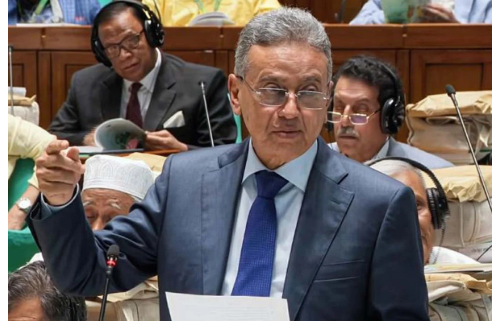
Bangladesh’s total public debt stood at Tk 22,06,466 crore as of December 1, 2025, Finance Minister Amir Khasru Mahmud Chowdhury informed Parliament on Sunday.
Responding to a written question from lawmaker Md Golam Ruhul, the finance minister said the government’s total debt comprises Tk9,59,315 crore in external debt and Tk12,47,151 crore in domestic debt. Speaker Hafiz Uddin Ahmed Bir Bikram presided over the House during the session.
The finance minister said the government is placing greater emphasis on increasing both tax and non-tax revenues to reduce the growing burden of domestic and external borrowing. The revenue-to-GDP ratio has been set at around 10.4 percent for the current fiscal year, with the aim of boosting revenue collection and reducing reliance on loans.
He said the government has adopted a Medium-Term Debt Management Strategy (MTDS) to reduce the cost and risks associated with public debt and to ensure a more structured and sustainable approach to debt management.
Amir Khasru said the government is pursuing a transition from a debt-driven economy to an investment-led economy, a policy also highlighted in the current fiscal year’s budget. Higher returns on public investment, he noted, would strengthen revenue collection and gradually reduce the need for borrowing to finance budget deficits.
To ease interest payment pressures, the government is also focusing on diversifying its investment profile. Initiatives have been taken to expand alternative financing instruments, including Sukuk and asset securitisation, he added.
The minister said Bangladesh continues to borrow from both bilateral and multilateral development partners but is prioritising concessional loans, which offer lower interest rates and longer repayment periods.
He also outlined several measures being implemented by the Finance Division to manage rising debt obligations. These include conducting Debt Sustainability Analysis (DSA) to assess debt stability and risks, strengthening efforts to increase export earnings, remittance inflows and foreign exchange reserves, and enhancing oversight of government-guaranteed loans and liabilities of state-owned enterprises.
The government believes these measures will help maintain fiscal stability while supporting long-term economic growth and reducing dependence on borrowing, the minister added.