


 Play store

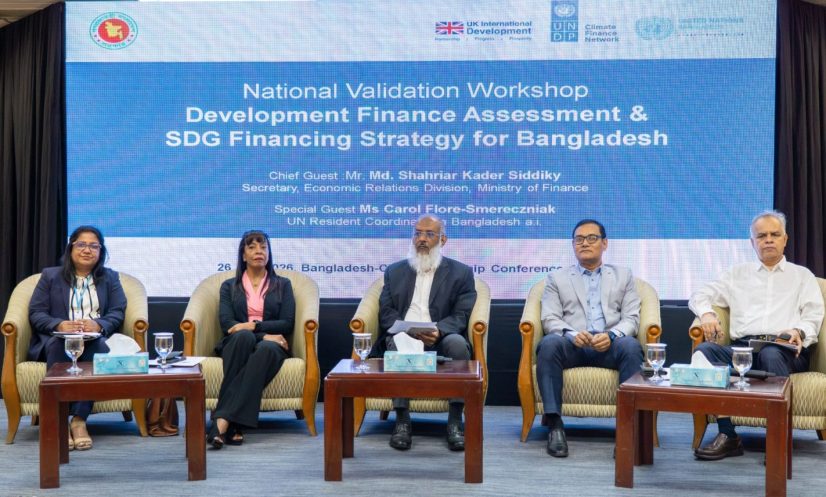
Bangladesh will require an additional $421 billion in financing over the next five years to achieve the Sustainable Development Goals (SDGs) by 2030, according to a new government assessment presented at a national workshop in Dhaka on Sunday.
The Economic Relations Division (ERD), with support from the United Nations Development Programme (UNDP) and the UN Resident Coordinator’s Office, organised the National Validation Workshop on the Development Finance Assessment (DFA) and SDG Financing to review the country’s financing needs and strategies for meeting the global development targets.
The workshop examined findings from the Development Finance Assessment, a global framework designed to align financing policies, institutions and financial flows with national development priorities. Participants also reviewed Bangladesh’s updated SDG Financing Strategy, which will be finalised after incorporating recommendations from the event.
Presenting the assessment, Professor Dr. Selim Raihan of the University of Dhaka said Bangladesh is expected to face a financing gap of $421 billion during FY2026-FY2030, with the bulk of the required resources needing to come from domestic public and private financing, climate finance and international partnerships.
ERD Secretary Md. Shahriar Kader Siddiky acknowledged that the remaining years leading to the 2030 deadline would be particularly challenging.
“The financing gap is large, the time available is limited, and the global environment remains uncertain. Nevertheless, I remain confident that Bangladesh can make meaningful progress,” he said.
He stressed that achieving the SDGs will require clear national priorities, stronger coordination among stakeholders, improved governance and effective implementation of development programmes.
UN Resident Coordinator Carol Flore-Smereczniak highlighted the growing importance of domestic resource mobilisation as external development financing becomes increasingly constrained.
“Opportunities for development financing are shrinking globally. This creates an opportunity for Bangladesh to increase domestic investment in the SDGs by raising the tax-to-GDP ratio and encouraging greater private-sector investment aligned with sustainable development,” she said.
Chairing the event, ERD Additional Secretary A.H.M. Jahangir underscored the need for a comprehensive financing framework as Bangladesh prepares for its graduation from the Least Developed Country (LDC) category.
UNDP Deputy Resident Representative Sonali Dayaratne said the widening financing gap calls for stronger economic governance and innovative financing mechanisms.
“The government can use public resources strategically to leverage and de-risk private investment. Addressing the financing challenge requires a transparent and accountable financial ecosystem supported by sound policies and effective partnerships,” she said.
Supported by the UNDP Climate Finance Network Programme, funded by the UK’s Foreign, Commonwealth & Development Office (FCDO), the workshop brought together senior government officials, development partners, financial institutions, academics and civil society representatives to discuss practical strategies for mobilising the resources needed to achieve Bangladesh’s SDG commitments by 2030.