


 Play store

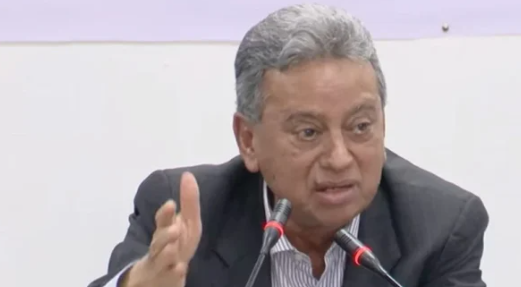
Finance Minister Amir Khosru Mahmud Chowdhury has said Bangladesh’s electricity and gas shortages cannot be resolved overnight, stressing that the government inherited the crisis and is using all available resources to gradually improve the situation.
“This is not a problem created by the present government. It is an inherited crisis,” he said, adding that the government was making every possible effort to improve energy supplies.
The minister was speaking at a seminar titled “Biannual Economic Situation of FY2026: Revenue and Monetary Policy Perspectives and Private Sector Expectations”, organised by the Dhaka Chamber of Commerce and Industry (DCCI) at its auditorium in Motijheel, Dhaka, on Saturday.
Amir Khosru said the country’s stock position in several critical sectors was extremely fragile when the government took office. In some cases, reserves were not even sufficient for 15 or 17 days.
“We have now brought those stocks up to around one month and are gradually working to build three months of reserves in every critical sector,” he said, stressing that energy security is one of the most important requirements for economic growth.
The minister acknowledged that the electricity and gas crisis would take time to overcome.
“We are making every effort and using the resources available to us, but everything is not within the government’s control,” he said, urging industries to take this reality into account.
He said the energy shortage was causing difficulties for businesses and industries and could also contribute to rising non-performing loans (NPLs).
Against this backdrop, Bangladesh Bank has introduced a package that includes loan rescheduling and grace periods, he said. The package also provides policy space for businesses that want to exit their operations.
The minister said changes were needed in the mindset of bankers, particularly regarding loans that have little realistic prospect of being recovered.
“A loan may remain on a bank’s balance sheet, but if there is no real possibility of recovering the money, there is no point in keeping it there merely on paper,” he said, stressing the need to clean up banks’ balance sheets and create genuine liquidity.
He said Bangladesh Bank’s package would come into effect on September 1. He urged businesses that qualify for the package but face obstacles at banks to inform the government.
The government has also introduced a Tk 60,000 crore financing package for micro, small and medium enterprises, the finance minister said. He acknowledged that such financing programmes had previously been marred by irregularities and interference by influential quarters.
“This time there will be no scope for political influence or patronage,” Amir Khosru said, adding that there would also be no political appointments in the financial sector.
Banks, he said, would have to lend only to businesses and entrepreneurs who meet prescribed criteria.
“The financial sector must operate according to market rules,” he said, adding that the government was working to establish a banking system free from political influence.
Speaking at the seminar, CPD Distinguished Fellow Professor Mustafizur Rahman said achieving the revenue collection target set in the current budget would be extremely difficult.
The government has set a revenue target of Tk 4.95 lakh crore for the current fiscal year, he said, noting that achieving it would require growth of around 45% over actual collections in the previous period.
“Is such a high growth rate realistic?” he asked.
Mustafizur said the budget contained several investment- and business-friendly proposals, but these would not deliver the desired results without better coordination between fiscal and monetary policies.
While the government wants to boost investment through fiscal and financial measures, he said high interest rates were increasing the cost of borrowing for businesses.
Private-sector credit growth has fallen to around 5%, against the Bangladesh Bank target of 9%, he said. With lending rates for entrepreneurs hovering around 14-15%, investment is facing a major constraint.
The economist also pointed to logistics and other non-financial costs that are raising the overall cost of doing business. He called for a broader rethink of economic policy instead of relying solely on contractionary monetary policy to control inflation.
Mustafizur also questioned the government’s ability to implement the Annual Development Programme (ADP) effectively. The current budget has allocated around Tk 3 lakh crore for the ADP, while only Tk 1.41 lakh crore was implemented in the previous fiscal year.
He said this was among the lowest implementation rates recorded and warned that a major improvement in institutional capacity would be needed to implement the much larger allocation.
He also criticised the recurring tendency to accelerate project spending during the final quarter of the fiscal year, saying that the practice raises questions about the economic benefits of projects and the efficient use of public money.
To increase revenue collection, Mustafizur recommended greater use of digitalisation, artificial intelligence and QR codes. He said systems should be strengthened to ensure that a larger share of the VAT paid by consumers actually reaches the government treasury.
Policy Research Institute Chairman Dr Zaidi Sattar said the private sector remained the main engine of Bangladesh’s economic growth and that the government’s primary responsibility was to create an appropriate policy framework for business and investment.
With Bangladesh’s LDC graduation approaching, he said the country could no longer afford to wait for economic conditions to improve on their own.
Bangladesh has long talked about export diversification, but apart from ready-made garments, no other major sector has emerged at the desired scale, he said.
Zaidi identified the country’s high and complicated tariff structure and excessive protection of imports as major reasons behind the lack of diversification.
Because of the protection enjoyed by the domestic market, he said, many entrepreneurs find selling products locally more profitable than exporting them.
He called for rationalising the tariff structure to encourage non-garment exports.
PPRC Executive Chairman and BRAC Chairman Dr Hossain Zillur Rahman said many obstacles to business and investment do not directly generate government revenue but impose a significant burden on the economy.
He described these costs as a form of “harassment tax”, referring to delays in obtaining approvals, certifications and services from government agencies.
Reducing this burden should not take even a year if there is political will, he said.
Bangladesh must now focus not only on resilience but also on bringing greater “speed” to the economy, Hossain Zillur said, noting that competing countries were moving ahead rapidly.
He called for faster reforms and investment implementation, while stressing that productive employment must come from structural transformation rather than relying solely on government projects.
On NPLs, he said not all bad loans resulted from wilful default. Many businesses had faced difficulties because of prolonged delays in approvals and environmental or other administrative complications.
He therefore called for greater attention to the structural causes behind bad loans.
Hossain Zillur welcomed initiatives by Bangladesh Bank and the Palli Karma-Sahayak Foundation to expand financing for small and cottage industries. He also proposed establishing an Economic Reform Accelerator Unit with executive authority to speed up implementation of reforms.
Finance Minister Amir Khosru said solving the country’s economic problems would require collective efforts rather than relying solely on the Finance Ministry or the government.
“There is no alternative to investment if we are to revive the economy,” he said, stressing that greater domestic investment would also be necessary to build confidence among foreign investors.
Bangladesh’s past economic growth had largely been driven by private-sector investment, he said, adding that the private sector would remain the principal driver of growth in the future.
The government is also prioritising deregulation to improve the business environment, the minister said. A committee has already been formed for this purpose, while a website is being developed through which businesses will be able to report obstacles to the implementation of government decisions.
He urged business organisations to take an active role in addressing such barriers rather than merely lodging complaints.
The government has also been working with customs, ports and private-sector representatives to set specific timelines for clearing goods, he said. Each process would be assigned a deadline so businesses know how long a particular service should take.
“No government decision will remain open-ended,” Amir Khosru said, adding that every decision would have a defined implementation timeline.
ICC Bangladesh President Mahbubur Rahman, Transcom Group Chief Executive Officer Simin Rahman, business leaders and economists also attended the seminar.
The discussions covered revenue mobilisation, monetary policy, investment, banking-sector reform, LDC graduation, export diversification, energy security and barriers facing the private sector.