Play store

Bangladesh Poribesh Andolon (BAPA) has proposed a six-point roadmap for sustainable municipal waste management, calling for waste to be treated as a resource rather than a burden.
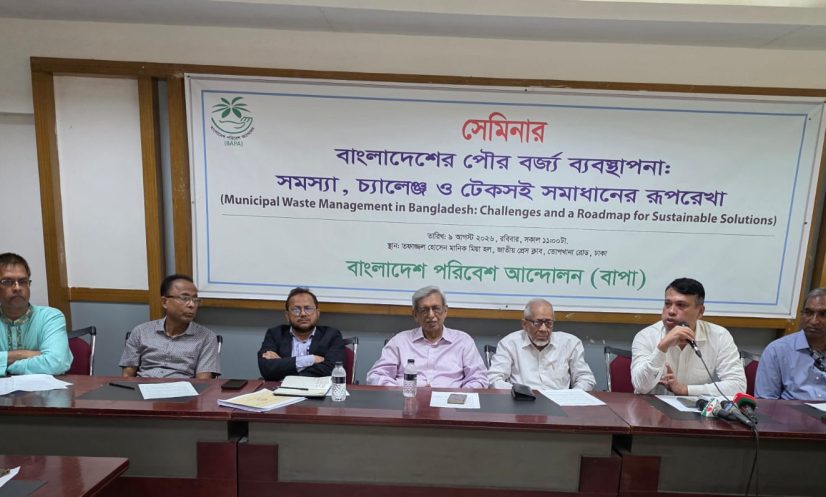
The recommendations were made at a seminar titled “Municipal Waste Management in Bangladesh: Challenges and a Roadmap for Sustainable Solutions”, organised by BAPA at the Tafazzal Hossain Manik Mia Hall of the National Press Club on Sunday.
BAPA President Prof Dr Nur Mohammad Talukder chaired the seminar, while its General Secretary Md Alomgir Kabir moderated it. Waste management expert and BAPA life member Dr Nasir Uddin Khan presented the keynote paper.
BAPA Vice-President Mahidul Haque Khan delivered the welcome address.
In his keynote presentation, Dr Nasir said Bangladesh’s waste management system remains largely dependent on a “collect, transport and dump” approach, resulting in inadequate recycling, resource recovery and energy generation.
A large volume of waste is also ending up in open spaces, wetlands and water bodies, putting growing pressure on the environment and the economy, he said.
The current system is contributing to methane emissions, pollution of rivers and water bodies, siltation of riverbeds, waterlogging, air pollution and increased risks of dengue and other public health problems, according to the presentation.
It is also causing economic losses through the wastage of valuable urban land, rising waste management costs and the loss of recyclable materials, energy, employment opportunities and potential revenue, he said.
Dr Nasir said Bangladesh should prioritise simple, low-cost and locally manageable technologies and suggested that biogas, compost and refuse-derived fuel (RDF) could offer greater potential than expensive waste-to-energy options.
He assessed biogas/RDF technology as having “very high suitability” for Bangladesh, while describing landfill use for residual waste as having moderate to low suitability. Gasification was rated low and plasma pyrolysis very low in terms of suitability for the country.
He said a locally driven waste management system could help turn waste into recyclable resources, energy and economic opportunities while contributing to efforts to address Bangladesh’s ongoing gas and energy shortages.
BAPA President Prof Dr Nur Mohammad Talukder stressed the need for greater coordination among all agencies involved in environmental protection and waste management.
Prof M Firoz Ahmed, a noted water scientist and BAPA vice-president, said many bus stands in Dhaka had been built on former waste dumping sites.
He said waste at secondary dumping points could potentially be converted into useful fuel if measures were taken to prevent rainwater from entering the waste.
Prof Ahmed also suggested that city corporations could improve their financial position by collecting waste management fees directly from households and developing a market for compost produced from organic waste.
Noor Azizur Rahman, chief engineer of Dhaka South City Corporation, said poor waste management was contributing to waterlogging in Dhaka even after relatively light rainfall.
He said DSCC was already in discussions with a South Korean company on possible solutions, but further research and feasibility studies would be required before implementation.
He added that DSCC was planning to make the best possible use of expertise and technologies available in the country.
Md Arifur Rahman, additional chief waste management officer of Dhaka North City Corporation, said keeping the city’s drainage system and interconnected drainage channels clean had become a major challenge because of solid waste.
He said DNCC was working to launch a waste-to-energy project that, once fully operational, would process around 3,000 tonnes of waste a day.
According to him, around 30 acres of land had been sought for the project, which could generate an estimated 42-45 megawatts of electricity.
Engineer Shuvo Kibria, chief researcher at Consumers Association of Bangladesh (CAB), said the benefits to consumers should be considered before introducing any new product or project.
BAPA Vice-President Mahidul Haque Khan said the type and volume of waste generated in the country were changing gradually and called for the preparation of a comprehensive roadmap for waste management.
BAPA General Secretary Md Alomgir Kabir said the country’s waste management system was failing to make proper use of opportunities for energy generation, while large quantities of waste were being dumped in open spaces, wetlands and water bodies.
He presented the following six recommendations for sustainable municipal waste management:
Treat waste as a resource: Waste should be transformed into resources, energy and economic opportunities rather than being treated as a burden.
Promote biogas, compost and RDF: Considering the high organic content and moisture levels of Bangladesh’s municipal waste, the country should prioritise biogas, compost and RDF instead of relying on high-tariff waste-to-energy projects.
Create an RDF market: The government should formulate policies allowing RDF to be used as a co-fuel in coal-fired power plants and expand its use in industrial boilers, brick kilns and other suitable sectors.
Develop a national guideline: A National Solid Waste Management Guideline and Operational Handbook should be prepared covering all city corporations and municipalities. It should include a national municipal solid waste database, GIS-based waste generation and hotspot maps, scientific waste categorisation and a classification-based management framework for city corporations and municipalities.
Establish a Carbon Credit Cell: A dedicated Carbon Credit Cell should be established for waste management-related activities.
Build a low-cost, locally driven system: The proposed system should rely on affordable and simple technologies, domestic investment and local participation to establish an environmentally sound and sustainable waste management framework.
BAPA said such an approach could help convert waste into recyclable resources, energy and economic opportunities while making a meaningful contribution to addressing Bangladesh’s gas and energy challenges.
The seminar was attended by BAPA Treasurer Aminur Rasul, Joint Secretaries Dr Halim Dad Khan, Humayun Kabir Sumon and Javed Jahan, Executive Members Advocate Parvin Akter, Monsefa Tripti and Fahmida Naznin, as well as members of its central and national committees.