


 Play store

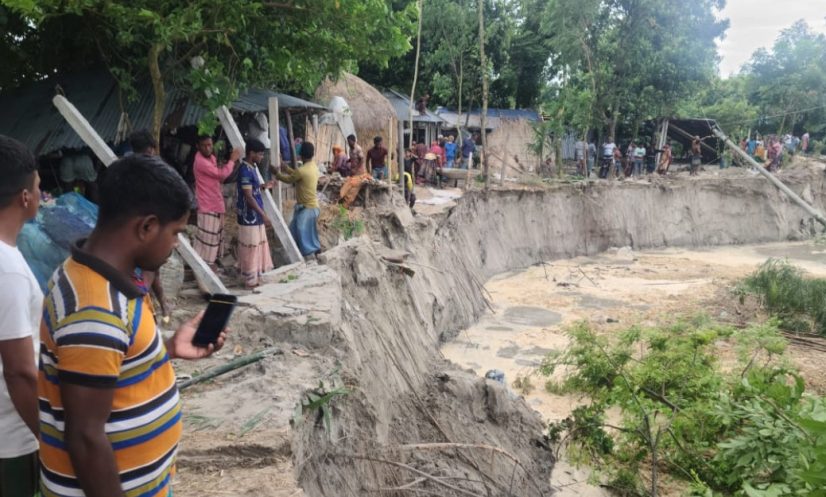
Rising water levels in Gaibandha’s major rivers amid heavy rain and upstream runoff have triggered severe riverbank erosion, leaving scores of riverside families without homes.
The situation is particularly critical in Sundarganj upazila, where erosion along the Teesta River has already swallowed the homesteads of 83 families, according to official figures.
Local residents, however, estimate that nearly 100 families have lost their homes since Wednesday.
The Bangladesh Water Development Board (BWDB) has begun emergency measures, including the dumping of geo-bags, to contain the erosion.
According to the latest BWDB data, recorded at 6pm on Friday, water levels rose by 20 centimetres in the Brahmaputra at Fulchhari, 14cm in the Ghaghat at New Bridge, 16cm in the Karatoya at Chak Rahimapur and 6cm in the Teesta at Kaunia over the previous 24 hours. None of the rivers had yet reached the danger level.
The district received 35mm of rainfall during the same period, raising concerns about possible flooding.
Riverbank erosion has also been reported in Gaibandha Sadar, Saghata and Fulchhari upazilas. In Sundarganj’s Kapashia Union, erosion at Lalachamar has taken a particularly serious turn.
Residents said the latest erosion has destroyed homes, trees, poultry farms and household belongings, with some families unable to move their houses and possessions to safety. More than 200 other families are reportedly at risk.
Locals said the area has experienced at least four major rounds of erosion during the current monsoon season, with the situation worsening as Teesta water continues to rise.
Earlier, on Aug 18, the Bhorrer Pakhi Government Primary School, the only educational institution serving children in the area, also came under threat from erosion. School authorities were forced to quickly relocate its infrastructure to a safer location.
Sundarganj Upazila Nirbahi Officer Iffat Jahan Tuli said officials had visited the affected areas and provided dry food to displaced families.
A list of affected households is being prepared so that assistance can be provided according to government rules.
She added that the BWDB had begun placing geo-bags to protect vulnerable riverbanks.
Gaibandha BWDB Executive Engineer Shariful Islam said around 2,000 geo-bags had already been placed on an emergency basis in Sundarganj.
He said authorities were closely monitoring erosion-prone areas across the district and taking necessary measures based on field reports. With river levels continuing to rise, he warned that a minor flood could also occur.