Play store

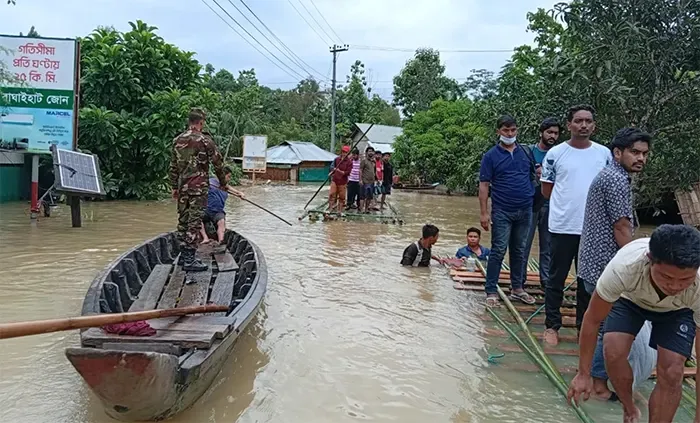
Torrential rainfall and upstream hill runoff over the past six days have triggered severe flooding across southern Chattogram, leaving more than 450,000 people stranded and facing acute shortages of food and safe drinking water.
At least 15 upazilas—including Satkania, Banshkhali, Chandanaish, Lohagara, Patiya, Boalkhali, Anwara, and Hathazari—have been inundated, submerging vast low-lying areas.
Satkania has been the worst affected, with nearly 80 percent of the upazila under water and over 350,000 residents enduring severe hardship.
Thousands of homes have been flooded, with many mud-built and semi-permanent structures collapsing under the pressure of rising water.
Cooking has become nearly impossible in most areas, while access to clean water, dry food, and essential medicines remains critically limited.
Although some residents have taken shelter in designated centres, many families are still stranded in their homes or on higher ground, living in extremely difficult conditions.
Flooded roads have severely disrupted transportation, hampering relief distribution efforts.
According to the district administration, shortages of food, drinking water, and baby food are worsening in the affected areas.
Water levels in the Sangu and Dolu rivers have risen above danger levels, inundating new areas. In Satkania, floodwaters have entered key public facilities, including the upazila health complex, court premises, police offices, and municipal buildings. All educational institutions in the area have been closed.
A several-hundred-foot section of an embankment in Rampur collapsed under the force of hill runoff, further aggravating the flooding. Communication has been severely disrupted, as most roads remain submerged.
In Banshkhali, more than 500 mud houses have collapsed, while road links with Chattogram city were cut off after parts of the main highway went underwater.
Similarly, in Chandanaish, the Shankha River has overflowed beyond danger levels, inundating low-lying areas and leaving at least 20,000 people stranded.
Floodwaters flowing over sections of the Chattogram–Cox’s Bazar highway have disrupted long-distance travel, causing severe traffic congestion and prolonged suffering for commuters.
The agriculture sector has suffered significant damage. According to the Department of Agricultural Extension, floodwaters have affected 6,591 hectares of Aus paddy, 565 hectares of Aman seedbeds, and 4,167 hectares of summer vegetables. Officials warn that losses could rise further if the water does not recede quickly.
The fisheries sector has also been badly hit. Thousands of ponds, reservoirs, fish farms, and shrimp enclosures across 153 unions have been inundated, with large quantities of fish and fry washed away.
Initial estimates indicate that 7,375 ponds and 45 shrimp farms have been affected, resulting in the loss of approximately 1,805 tonnes of fish and 4.84 million fry, with damages exceeding Tk 39 crore.
However, a broader field-level assessment suggests that up to 9,933 ponds and 320 fish farms may have been impacted, potentially pushing total losses to around Tk 91 crore.
Local fish farmers have reported devastating personal losses, with many losing their entire stock.
In Hathazari, valuable Halda River fry cultivated in local ponds were washed away, dealing a major blow to the region’s unique fisheries sector. Traders have warned that freshwater fish supply may decline in the coming months, potentially driving up market prices.
Residents across the affected areas report worsening humanitarian conditions. Many families are struggling to survive without adequate food or safe drinking water as floodwaters continue to rise.
“Water levels are increasing every day. Many people are going without food,” said a local resident, highlighting the growing crisis.
The Chattogram district administration has cancelled all officials leave and activated 24-hour control rooms in every upazila to monitor the situation and coordinate rescue and relief operations.
District Commissioner Zahidul Islam Mia said the administration remains on high alert, prioritising rescue efforts, relief distribution, and overall monitoring.
He added that once floodwaters recede, a comprehensive list of affected people will be prepared to ensure necessary government assistance.
With water levels still rising in several areas and communication networks severely disrupted, the flood situation remains critical.
Ensuring rapid relief delivery and the quick recession of floodwaters are now the most pressing challenges.
Unless conditions improve soon, the disaster could worsen further, posing serious risks to livelihoods, food security, and public health across the region.