


 Play store


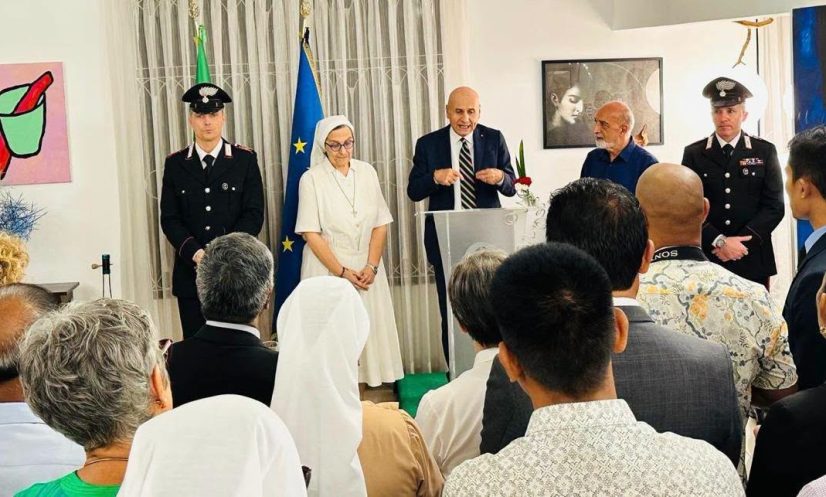
There are countless stories of people crossing borders, geography and religious identities to devote their lives to serving others. Yet the decades of quiet sacrifice and selfless service by Italian missionaries in independent Bangladesh occupy a particularly meaningful place in that history.
From leprosy and tuberculosis patients in the storm-battered coastal districts of southern Bangladesh to the Santal communities of the northern plains and disadvantaged children in the remote valleys of the Chittagong Hill Tracts, Italian priests and nuns have stood beside some of the country’s most marginalised people—with compassion, dignity and an extraordinary sense of responsibility.
The recent decision by Italian President Sergio Mattarella to confer one of Italy’s prestigious state honours, the Cavaliere dell’Ordine della Stella d’Italia (Knight of the Order of the Star of Italy), on two dedicated Italian missionaries—Sister Roberta Pignone and Father Pietro Luigi Lupi—is therefore more than a recognition of two individuals.
It is also a historic acknowledgement of decades of pastoral, medical and socio-economic service in Bangladesh. The honour brings renewed recognition to the work of the Catholic Church and is a source of pride for the wider Italian community living in Bangladesh. The Order of the Star of Italy is among the country’s distinguished civilian honours and is awarded to individuals whose contributions have enhanced Italy’s image abroad or strengthened relations between Italy and other countries.
A doctor beyond the hospital walls
Sister Roberta Pignone’s contribution to healthcare, particularly in the underserved areas of southern Bangladesh, is remarkable.
A member of the Missionary Sisters of the Immaculate, popularly known in Bangladesh as the PIME Sisters, Sister Roberta is a trained physician who has devoted herself to communities in the remote and disadvantaged coastal areas of the country.
For more than a decade, she has served as project director and the only full-time physician at the historic Damien Hospital under the Diocese of Khulna. The hospital provides specialised care to people affected by leprosy, tuberculosis and HIV/AIDS—conditions that have often subjected patients to stigma, discrimination and social isolation.
Sister Roberta oversees the 33-bed hospital as well as three rural clinics and 15 tuberculosis control centres. But her work does not end at the hospital gates. She has continued to visit densely populated slum areas of Khulna and the homes of extremely poor families, promoting basic health awareness and distributing quality medicines free of charge.
Her work with patients suffering from leprosy and tuberculosis goes beyond medical treatment. She has also fought the stigma, fear and discrimination that can force patients away from their families and communities. In doing so, her medical mission has evolved into a broader humanitarian effort—one aimed at restoring dignity as much as health.
Education as a path to dignity
Father Pietro Luigi Lupi, affectionately known in Bangladesh as Father Lupi, has pursued a similarly quiet but profound social mission through education, child protection and the promotion of the rights of ethnic minorities.
A priest of the Italian Catholic Xaverian Fathers and a former Regional Superior of the order in Bangladesh, Father Lupi has spent years working with poor, vulnerable and ethnic minority communities.
His contribution to the socio-economic transformation of Dalit communities in Satkhira and Khulna is particularly significant. With his encouragement, guidance and direct support, local Dalit youths have gained opportunities for higher education and have worked to establish their legal and social rights. They also built an organisation under the name ‘Dalit’ to advance their community’s interests.
His work has not been confined to rural communities. Near Tejgaon Railway Station in Dhaka, he has supported schools and daycare facilities for children living in extremely poor and hazardous slum conditions, helping them avoid the traps of child labour and crime and instead find a path through education.
He has also remained involved in educational initiatives for children from indigenous communities in remote areas such as Lama in Bandarban.
In recent years, Father Lupi has worked closely with efforts to provide food, healthcare and humanitarian assistance to Rohingya refugees in Cox’s Bazar, while also helping bring their suffering and concerns to the attention of the international community. He has also provided financial assistance to disadvantaged students seeking higher education.
Friends during the Liberation War
The history of Italian missionary service in Bangladesh, however, goes much further back than the recent decades. Its roots are intertwined with one of the defining moments in Bangladesh’s history—the Liberation War of 1971.
Amid the brutality and mass killings carried out by Pakistani forces, Italian priests associated with the Xaverian and PIME missions transformed churches, mission facilities and shelters into places of refuge for terrified civilians, despite the risks to their own lives. They stood beside the people of the then East Pakistan who were fighting for freedom.
Father Marino Rigon was among those who played a particularly courageous role. At the Baniarchar parish, he secretly sheltered wounded freedom fighters, provided them with medical care and helped ensure their safety.
In recognition of his humanitarian contribution and friendship with the people of Bangladesh during the Liberation War, the government of Bangladesh awarded Father Marino Rigon the Friends of Liberation War Honour in 2012.
Father Rigon was one of the brightest figures among the Italian missionaries who devoted their lives to Bangladesh. He spent more than six decades in the country, contributing not only to education and humanitarian service but also to Bengali literature and culture.
His love for Bangladesh extended to its literary heritage. He translated major works of Rabindranath Tagore and poet Jasimuddin into Italian, introducing Bengali literature to a wider Italian and international audience.
In recognition of his contribution, the Bangladesh government granted him honorary citizenship in 2009.
Father Rigon died in Italy in 2017, but his final wish was to be buried in the land he had come to love as his own. In 2018, the Bangladesh government took the extraordinary step of bringing his remains from Rome to Shelabunia village in Mongla. A Bangladesh Police contingent presented a guard of honour, and he was buried with full state honours.
A bridge between communities
Father Paolo Ciceri and many other Italian PIME missionaries have also played important roles in the socio-economic development, education and land-rights struggles of Santal and other ethnic minority communities in northern Bangladesh. Their contributions have received recognition from local administrations as well as at the national level.
The significance of this legacy, however, extends beyond individual acts of charity. It offers a deeper lesson about religious harmony and human connection.
Bangladesh’s first Cardinal, Patrick D’Rozario, CSC, has rightly emphasised the importance of Christians working as bridges of harmony to dispel mistrust and misconceptions among people of different faiths. Genuine interfaith dialogue and relationships built through direct human engagement and compassion can contribute to a more peaceful society.
This is perhaps the most enduring lesson of the Italian missionary presence in Bangladesh.
At a time when the world is increasingly marked by geopolitical polarisation, economic self-interest and intolerance, their lives remind us that humanity cannot be confined by geography, nationality or institutional identity.
The quiet work of people like Sister Roberta Pignone and Father Pietro Luigi Lupi has contributed to healthcare, education and social transformation in parts of Bangladesh where the needs have often been greatest and resources the scarcest.
Their service has also added a deeply human dimension to the relationship between Bangladesh and Italy. Bilateral relations are often discussed in terms of trade, investment, diplomacy and politics. But there is another foundation that is sometimes overlooked—the relationships built through decades of service, solidarity and affection between ordinary people.
The stories of these missionaries are part of that foundation.
They remind us that some of the most enduring contributions to a country do not come with fanfare. They are made quietly—in hospitals, classrooms, villages, shelters and homes—by people who choose to stand beside those who have the least.
Bangladesh owes a debt of gratitude to these quiet friends from Italy. Recognising their contribution is not merely an act of courtesy. It is a way of remembering a shared history of humanity, solidarity and friendship that has crossed borders and generations.
The views expressed in this article are the author’s own and do not necessarily reflect Sarabangla English Edition’s editorial stance.