


 Play store


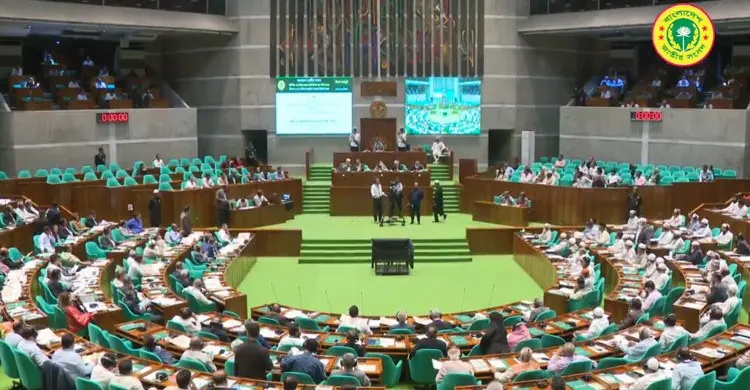
Bangladesh’s first budget session under the BNP government ended with a clear message that the administration intends to move fast on economic reforms and investment-friendly legislation. However, the pace that underscored the government’s reform agenda also revived a longstanding debate over whether Parliament is providing sufficient scrutiny of major laws and enough space for discussion on issues of national importance.
The second session of the 13th Jatiya Sangsad, held from June 7 to July 15, was the longest sitting of the year, spanning 26 working days. It was the first budget session of the government formed after the political transition of August 5 and served as an early test of its legislative priorities and the effectiveness of the new Parliament.
The House approved the Tk 9.38 lakh crore national budget for FY2026-27 after nearly 49 hours of debate involving 316 lawmakers from both the treasury and opposition benches. Parliament also passed 10 government bills, reflecting the government’s determination to sustain legislative momentum.
The session’s most significant development, however, came on its final day with the passage of the Investment Bangladesh Bill, 2026, a cornerstone of the government’s strategy to attract foreign investment.
Introduced on behalf of Prime Minister Tarique Rahman by Home Minister Salahuddin Ahmed, the bill was passed within just 28 minutes without being referred to the relevant parliamentary standing committee for detailed scrutiny.
The law merges the Bangladesh Investment Development Authority (BIDA), Bangladesh Economic Zones Authority (BEZA) and the Public-Private Partnership (PPP) Authority into a single investment promotion agency.
It also repeals several existing laws, including the One-Stop Service Act, with the government arguing that a unified institutional framework will simplify investment procedures, improve efficiency and strengthen Bangladesh’s competitiveness in the global market.
Members of treasury bench described the legislation as a landmark reform aimed at sending a strong signal to international investors. Opposition lawmakers, however, argued that a bill with wide-ranging legal, administrative and economic implications deserved detailed committee examination rather than expedited approval.
Besides the investment law, Parliament passed amendments relating to narcotics control, gambling prevention, public examination offences and Bangladesh Medical University. Opposition MP Md Shahjahan Chowdhury also introduced two private member’s bills, although both were later withdrawn after receiving government assurances.
Despite the active legislative agenda, several pressing national issues remained largely absent from parliamentary debate. The proposed trade agreement with the United States, India’s pushback of people across the border and the recent floods affecting different parts of the country were not discussed separately in the House.
Opposition MPs argued that Parliament should have been the principal platform for reviewing the government’s response to these developments and outlining future policy directions.
The session also witnessed controversy over the formation of 18 parliamentary committees, including a special committee tasked with recommending constitutional amendments in line with the July National Charter and relevant High Court verdicts.
The opposition refused to nominate members for its five allocated seats, insisting that constitutional reform should instead be undertaken through a Constitution Reform Council in accordance with the mandate of the February 12 referendum. When the committee was formed on July 13 without opposition representation, opposition MPs staged a walkout.
Speaking on behalf of the opposition, Jamaat-e-Islami MP Najibur Rahman said constitutional reform required broader national consensus rather than a committee dominated by the ruling party. He also alleged that opposition lawmakers had not been given adequate opportunities to participate in debates on the budget, major legislation and other important national issues.
Chief Whip Md Nurul Islam Moni, however, rejected the allegations, saying proceedings were conducted strictly in accordance with the Rules of Procedure. He maintained that opposition MPs had been given more speaking opportunities than initially allocated and that time constraints made it impossible to accommodate every request.
Parliamentary statistics reflected active participation but also highlighted procedural limitations. Lawmakers submitted 715 notices under Rule 71, of which only 24 were accepted and 22 discussed. Another 125 notices were debated under Rule 71A, while four motions under Rule 131 were disposed of. MPs also submitted 278 questions for the Prime Minister and 5,031 questions for ministers.
The Speaker repeatedly reminded members to maintain decorum, avoid personal attacks, remain relevant to the subject under discussion and rely on verified information during debates.
The government’s first budget session reflected an administration eager to advance reforms and improve the investment climate. Yet the swift passage of major legislation, limited discussion of key national challenges and continuing disputes over parliamentary participation suggested that future sessions will be judged not only by the speed of lawmaking, but also by the quality of legislative scrutiny, inclusiveness and democratic accountability.
The views expressed in this article are the author’s own and do not necessarily reflect Sarabangla English Edition’s editorial stance.