


 Play store

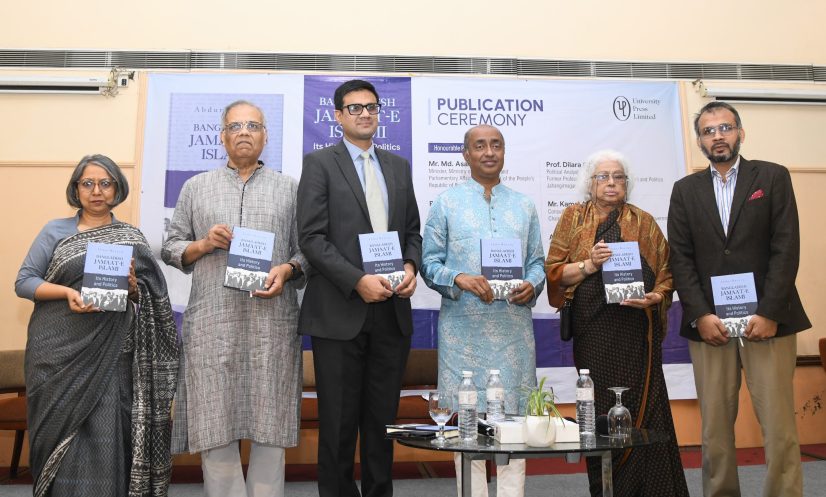
Law, Justice and Parliamentary Affairs Minister Md Asaduzzaman has said that people in a democratic society do not have to agree with everything said by an individual or political party, but rejecting criticism simply because it is disliked is also not appropriate.
“Having the mindset to accept others’ views and criticism is important for a democratic society,” he said.
The minister made the remarks as a panellist at the launching ceremony of Bangladesh Jamaat-e-Islami: Its History and Politics, written by Barrister Abdur Razzaq, at Lakeshore Grand Hotel in Dhaka on Friday.
Describing the book as more than a literary or research work, Asaduzzaman said it reflected the author’s philosophy of life, thoughts, ideas and experiences of observing society.
Referring to Abdur Razzaq’s views on the state and society discussed in the book, the minister said the proper way to establish an Islamic system of governance was not to impose it from above, but to build and run a state based on Islamic values emerging from society.
Speaking about the younger generation, Asaduzzaman said society must adapt to change to move forward. He said the July mass uprising had brought to the fore a generation’s desire for change, while Abdur Razzaq’s book also reflected important perspectives on political thought and change.
Referring to the author’s assessment of the 1971 Liberation War and the political context of that period, the minister said Abdur Razzaq’s position and statements to the nation on the issue were significant.
Had that position been made clear earlier, many questions surrounding the issue might have been resolved, he said.
Speaking about Abdur Razzaq’s organisational role, Asaduzzaman said that although he served as an assistant secretary-general of Jamaat-e-Islami, he had established an identity of his own through his work, thoughts, philosophy and ideals.
“The respect he earned in society and internationally was greater than what his organisational position alone could explain,” the minister said.
Asaduzzaman said Abdur Razzaq had encouraged international campaigning against fascism from a human rights perspective.
He said the late lawyer and political thinker viewed human rights as a means of raising concerns about fascism in international diplomatic circles.
Recalling his personal and professional interactions with Abdur Razzaq, the minister said he had met him over tea during visits to London and had also spoken to him by telephone.
He said Abdur Razzaq, while receiving treatment in hospital towards the end of his life, had expressed a wish to be buried in Bangladesh.
“His wish was fulfilled,” Asaduzzaman said, praying for the salvation of the deceased’s soul.
The minister also said Bangladesh Jamaat-e-Islami: Its History and Politics should be read particularly by people involved in politics.
Published by University Press Limited, the book examines the history and politics of Bangladesh Jamaat-e-Islami through Abdur Razzaq’s perspective and experiences.
Other panellists at the event included Ali Riaz, distinguished professor in the Department of Politics and Government at Illinois State University; John Danilovich, president of Washington, DC-based Right to Freedom and a former US diplomat; former Jahangirnagar University professor of Government and Politics Dilara Chowdhury; and Kamal Ahmed, consulting editor of The Daily Star and former chairman of the Media Reform Commission formed during the previous interim government.