Play store

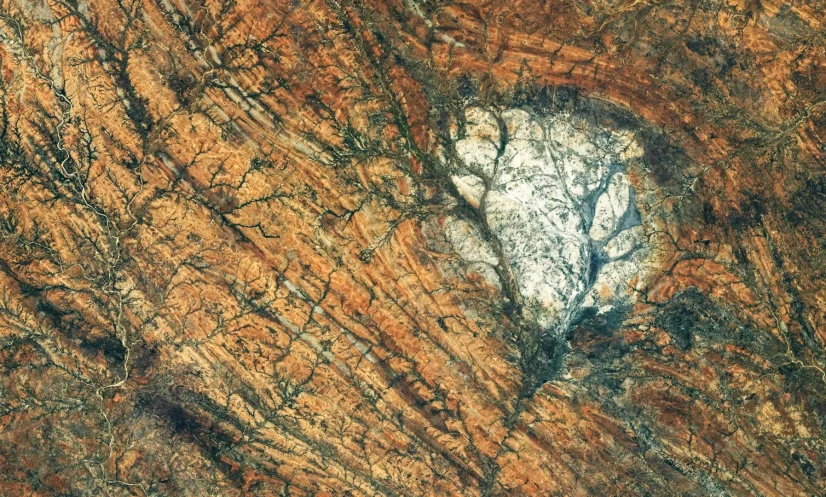
A striking rock formation in southern Madagascar has a geological connection to the Moon, offering scientists an opportunity to better understand the history of both Earth and its natural satellite.
Photographed by an astronaut aboard the International Space Station on August 28, 2026, the Saririaky anorthosite massif stands out against the region’s dry landscape. The light-coloured rock is similar to the material that makes up much of the Moon’s bright highlands, visible from Earth with the naked eye.
Anorthosite is an igneous rock found on both Earth and the Moon. Besides Madagascar, significant deposits occur in eastern Canada, Scandinavia and southern India.
The Saririaky massif is an exposed rock formation covering about 100 square kilometres. Geological research suggests it originated during the late Precambrian period, at least 600 million years ago.
Anorthosite is an intrusive igneous rock, meaning it forms when molten material cools and solidifies beneath the surface. The slow cooling process allows relatively large mineral crystals to develop.
The surrounding landscape also preserves evidence of powerful geological forces that reshaped the region hundreds of millions of years ago.
The Saririaky massif lies within a geological structure known as a ductile shear zone, where rocks are intensely deformed by pressure and heat deep inside Earth’s crust.
Under such conditions, rocks can bend, stretch and change their internal structure without breaking apart. These processes can also alter their mineral composition and texture through metamorphism.
Researchers have identified long, roughly parallel geological features running from north to south in the region. These formations record the intense deformation associated with the assembly of Gondwana, an ancient supercontinent that included parts of present-day Africa, India, Madagascar, Australia and Antarctica.
As the continental fragments collided, enormous pressure and heat transformed large sections of Earth’s crust.
Scientists have proposed that another anorthosite massif, located about 60 kilometres north of Saririaky within the same shear zone, may once have been connected to it.
According to this interpretation, tectonic forces stretched and separated the original rock body into distinct segments. The process, known as boudinage, occurs when a relatively strong layer of rock is pulled apart as the surrounding material deforms.
If confirmed, the relationship between the two formations could provide further evidence of the forces that helped assemble Gondwana.
Anorthosite is particularly important to planetary science because similar rocks help researchers investigate the Moon’s early history.
The Moon’s anorthosite-rich highlands are more than four billion years old. Scientists believe they formed when the young Moon was largely covered by an ocean of molten rock.
As the lunar magma ocean cooled, certain minerals crystallised and accumulated near the surface, forming much of the Moon’s early crust. The resulting anorthosite remains a major component of the bright highlands visible today.
Samples of lunar anorthosite collected by Apollo astronauts have helped scientists reconstruct the Moon’s formation and evolution. However, lunar samples remain limited, making comparable rocks on Earth valuable for geological studies.
One particularly close terrestrial comparison is found in Montana’s Beartooth Mountains, where anorthosite deposits have a composition similar to that of lunar rocks.
Although Earth’s anorthosite formations developed under different geological conditions, studying them can help scientists examine mineral structures and processes relevant to the Moon.
The Saririaky massif therefore offers more than a striking feature in satellite imagery. Its rocks preserve evidence of ancient continental collisions while providing a terrestrial comparison for understanding the processes that shaped the Moon’s earliest crust.