


 Play store

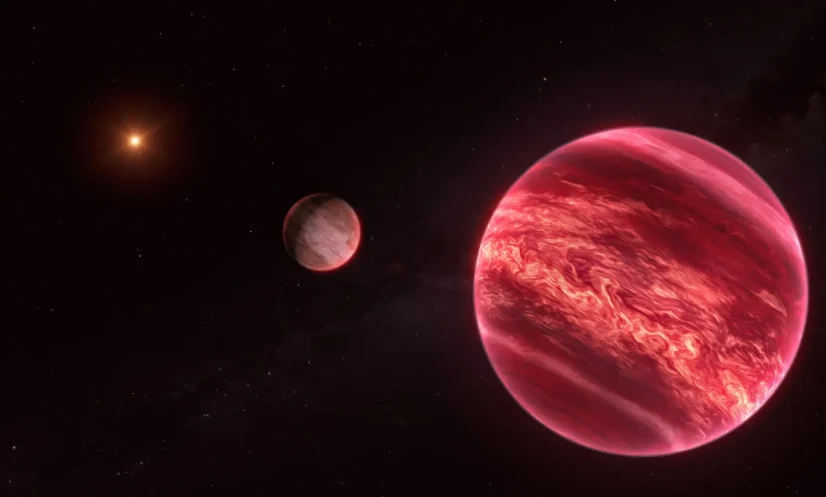
Astronomers have found evidence of a giant moon-like object beyond our Solar System, orbiting a brown dwarf rather than a planet, in a discovery that could challenge conventional definitions of moons and planets.
Observations made with the European Southern Observatory’s Very Large Telescope (VLT) revealed the possible satellite in the CD-35 2722 star system. If confirmed, it would mark a major breakthrough in the search for natural satellites beyond our Solar System.
The object, described by researchers as an exosatellite, has at least as much mass as Jupiter, while the brown dwarf it orbits is more than 30 times as massive as Jupiter.
The findings were reported in the journal Nature by a team led by Kevin Hoy, an ESO student based in Chile and affiliated with Universidad Diego Portales and the Millennium Nucleus of Young Exoplanets and their Moons (YEMS).
The CD-35 2722 system differs significantly from our own Solar System. At its centre is a star with about half the mass of the Sun. A brown dwarf orbits the star, while the newly identified object circles the brown dwarf.
Brown dwarfs occupy a middle ground between planets and stars. They are more massive than planets but generally lack the mass needed to sustain the hydrogen fusion that powers ordinary stars.
The suspected satellite is itself so massive that it could qualify as a planet under some classification systems. However, because it orbits a brown dwarf that circles a star, astronomers face difficulties describing its status using familiar astronomical terms.
“This system is somewhat hard to define using Solar-System-based words like ‘planet’ and ‘moon’,” Hoy said.
He described the arrangement as unusual, noting that the object could be considered a moon because it orbits another celestial body, despite being far larger than any natural satellite in our Solar System.
Alice Zurlo, director of YEMS and a co-author of the study, said the object was a giant gaseous body orbiting a highly massive companion.
The discovery highlights the challenges astronomers face in classifying objects in distant planetary systems, where the boundaries between stars, planets and moons may be less clear than in our own cosmic neighbourhood.
An exosatellite is a natural satellite outside our Solar System. However, no universally accepted definition of an exomoon has been established, particularly for objects orbiting bodies that blur the distinction between planets and stars.
Scientists have been searching for moons beyond our Solar System for years, but no candidate has yet been confirmed conclusively. Although astronomers have discovered more than 6,000 exoplanets, evidence for exomoons remains limited.
Earlier in 2026, another research team reported possible evidence of a satellite in the HD 206893 system using the European Southern Observatory’s Very Large Telescope Interferometer. That finding, however, did not establish a definitive detection.
For the latest study, Hoy, Zurlo and their colleagues used the CRIRES+ instrument on the Very Large Telescope to investigate the CD-35 2722 system.
Their observations provided evidence for the giant satellite by measuring its influence on the motion of its much more massive companion.
Further observations will be needed to establish whether the object is indeed a natural satellite and to clarify its properties.
If confirmed, the discovery could expand astronomers’ understanding of how complex systems of stars, planets and satellites form and evolve, while raising new questions about how such objects should be classified.