Play store

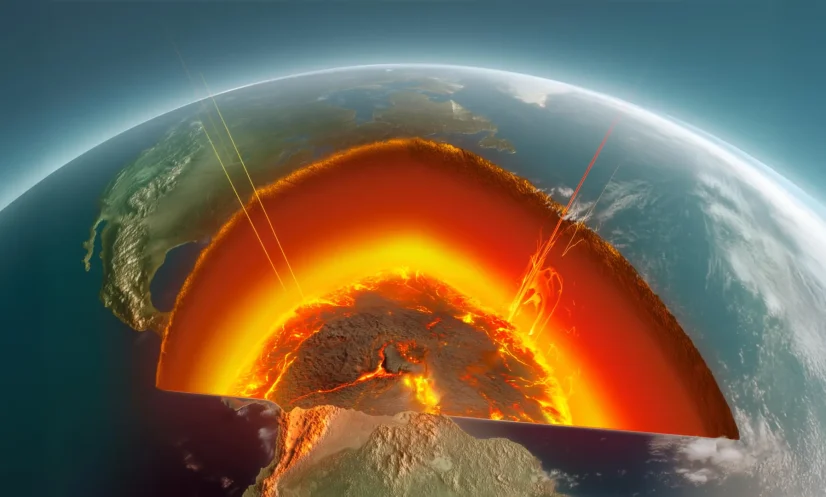
Scientists have discovered that molten rock deep inside Earth can store far more oxygen than previously believed, a finding that could offer new insights into the planet’s geological history and the evolution of its atmosphere.
The research suggests that oxygen can be incorporated into magma beyond the amount predicted by conventional chemical models. This raises the possibility that Earth’s interior may have played a previously overlooked role in the development of an oxygen-rich atmosphere billions of years ago.
The study was led by Dr Yanhao Lin and Dr Ho-kwang Mao of the Center for High Pressure Science and Technology Advanced Research (HPSTAR), in collaboration with Prof Haiyang Niu of Northwestern Polytechnical University and Prof Wim van Westrenen of Vrije Universiteit Amsterdam. The findings were published in National Science Review.
Oxygen is one of the most abundant elements inside Earth, accounting for more than half of the atoms in its silicate interior. However, scientists have traditionally assumed that magma’s oxygen content is constrained by the chemical composition and electrical charges of other elements, including silicon, magnesium and iron.
Unlike water and carbon dioxide, which can dissolve in magma and escape as gases when pressure falls, oxygen has generally not been considered a separate volatile component that molten rock can absorb and release.
To investigate this possibility, researchers recreated conditions deep inside Earth using laboratory equipment capable of generating extreme pressure and heat. They heated synthetic mid-ocean ridge basalt at temperatures ranging from 1,200 to 1,800 degrees Celsius and pressures reaching seven gigapascals, about 69,000 times atmospheric pressure at Earth’s surface.
The experiments showed that excess oxygen accounted for more than five per cent of the sample’s weight at the highest pressure tested. At normal atmospheric pressure, the amount was almost negligible.
Using Raman spectroscopy, the researchers found no detectable evidence of oxygen gas trapped in bubbles, suggesting that the additional oxygen had become incorporated into the structure of the resulting glass.
Computer simulations supported the experimental findings, showing that the ability of molten material to accommodate excess oxygen increased with pressure. The models also indicated that some oxygen atoms could form peroxide-like bonds, helping explain how the material stores oxygen beyond conventional chemical expectations.
The researchers cautioned that the measured concentrations might underestimate the amount originally held by the molten samples, as some oxygen may have escaped during cooling.
The findings could change scientists’ understanding of how oxygen behaves inside Earth’s mantle and how deep geological processes influence the atmosphere. However, further research is needed to establish how much excess oxygen occurs naturally in Earth’s interior and whether its release through volcanic activity significantly contributed to atmospheric oxygenation billions of years ago.