Play store

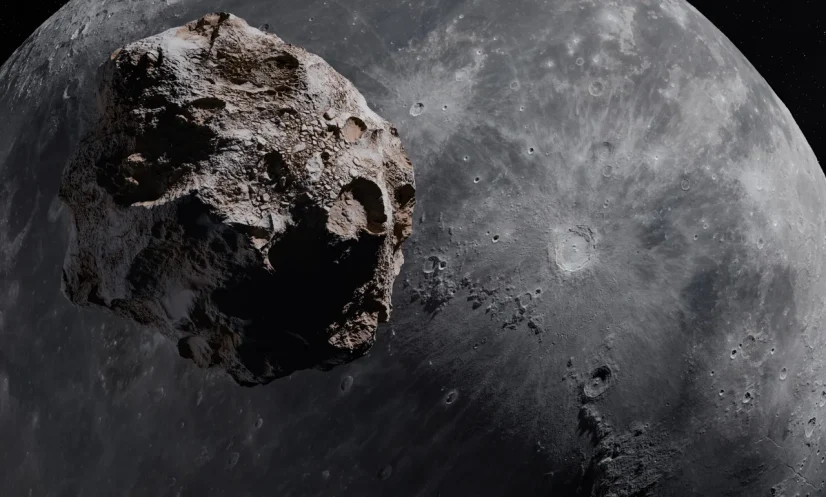
NASA has significantly reduced the likelihood of Asteroid 2024 YR4 colliding with the Moon in 2032, easing concerns over what scientists had described as a rare but potentially spectacular cosmic event.
The asteroid, first detected by the Asteroid Terrestrial-impact Last Alert System (ATLAS) on December 27, 2024, initially raised alarms because of a small possibility that it could strike Earth. That risk was quickly ruled out, but astronomers later estimated a 4.0 to 4.3 per cent chance that the space rock could instead hit the Moon on December 22, 2032.
Following updated observations and refined calculations of the asteroid’s orbit, NASA has now reported that the chances of a lunar impact have fallen significantly, indicating that the Moon is also unlikely to be struck.
Scientists estimate that Asteroid 2024 YR4 is about 200 feet (roughly 60 metres) wide. Had it collided with the Moon, it would have struck at a speed of nearly nine miles per second, creating a crater about 0.6 miles (one kilometre) wide and around 500 feet deep in the Moon’s southern region.
Earlier projections suggested the impact could have occurred at around 10:19 a.m. EST on December 22, 2032.
Researchers had said such an impact would have been one of the rare lunar collisions observed in advance. If the asteroid had struck the unlit, Earth-facing side of the Moon, the explosion could have produced a brilliant flash visible to skywatchers without telescopes.
European Space Agency (ESA) astrophysicist Richard Moissl had described the event as exceptionally rare, noting that scientists would have welcomed the opportunity to observe and analyse the impact in real time.
Astronomers estimated the flash could have remained visible for several minutes, reaching a brightness comparable to that of Venus in the night sky. Afterward, the impact site would likely have continued glowing in infrared light for several hours as molten rock gradually cooled, although that glow would not have been visible to the naked eye.
The latest update from NASA, however, indicates that such a dramatic lunar event is now far less likely, reflecting the increasing accuracy of asteroid tracking as additional observations refine the trajectories of near-Earth objects.
Scientists will continue monitoring Asteroid 2024 YR4 during future observation windows to further improve predictions of its orbit, but current assessments suggest that neither Earth nor the Moon faces a significant threat from the asteroid in 2032.