


 Play store

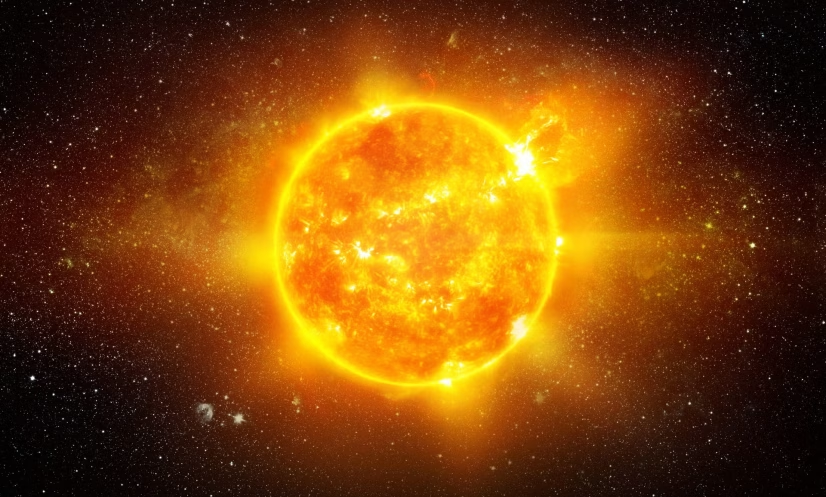
Scientists have discovered that the Sun contains significantly more silver than previously believed, a finding that could improve our understanding of the formation of stars, planets and the Milky Way galaxy.
Researchers at Uppsala University in Sweden found that the Sun’s silver abundance is about 55% higher than earlier estimates. The revised figure closely matches the amount of silver found in chemically primitive meteorites, helping resolve a long-standing discrepancy in astronomical measurements.
The study suggests that previous estimates underestimated the Sun’s silver content because they relied on simplified models of the solar atmosphere and the behavior of silver atoms.
“The new knowledge about the Sun’s composition is important for the understanding of other stars, planets and cosmic material, because the Sun is one of astronomy’s key reference points,” said Sema Caliskan, who conducted the research during her doctoral studies at Uppsala University’s Department of Physics and Astronomy.
Hydrogen and helium account for nearly all of the Sun’s mass, while heavier elements such as carbon, iron and silver make up only about 1.5%. Despite their tiny share, these elements provide vital clues about earlier generations of stars, where heavy elements were forged before being dispersed into space to form new stars and planets.
Astronomers determine the Sun’s chemical composition through spectroscopy, a technique that splits sunlight into its component wavelengths. Each chemical element absorbs light at specific wavelengths, leaving unique spectral lines that reveal its abundance.
Silver has been particularly difficult to measure because only two useful spectral lines from neutral silver atoms are visible, both in the near-ultraviolet region of the spectrum. These lines are faint and often overlap with signals from other elements, making precise measurements challenging.
To overcome these limitations, the researchers developed the first detailed non-equilibrium model for neutral silver atoms. Unlike earlier methods, the new approach accounts for the complex interactions between radiation and silver atoms across different regions of the Sun’s atmosphere.
The team also incorporated a sophisticated three-dimensional simulation of the Sun, capturing the movement of hot rising gas, cooler sinking material and temperature variations across the solar surface. These dynamic processes influence the appearance of spectral lines and cannot be accurately reproduced by traditional one-dimensional models.
The researchers also calculated previously unavailable atomic data, including transition probabilities and collision rates involving electrons and hydrogen atoms, further improving the accuracy of their analysis.
The findings provide a more reliable measurement of the Sun’s silver content and strengthen its role as a benchmark for studying the chemical composition of other stars and the evolution of the cosmos.