


 Play store

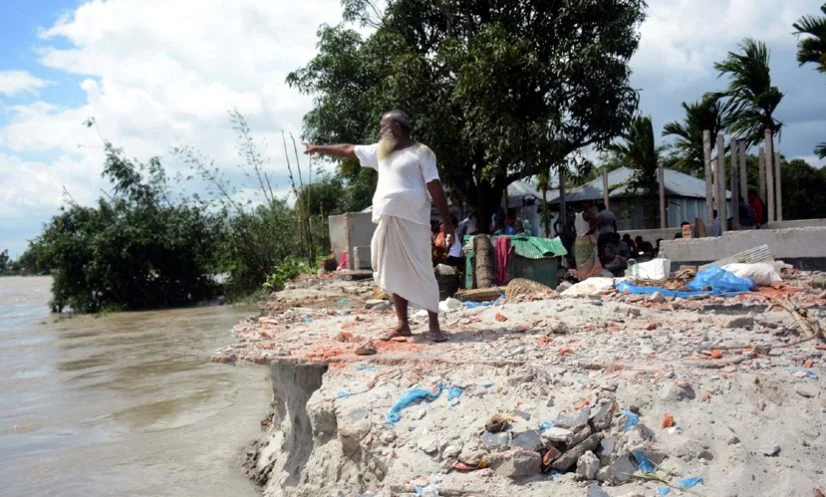
Severe riverbank erosion along the Teesta River has left dozens of families homeless and destroyed vast areas of farmland in northern Bangladesh, as repeated flooding triggered by upstream water flows and continuous rainfall continues to batter the region.
For Mofazzal Hossain of Kacharipara village in Gangachara upazila’s Nohali Union, the latest erosion marks yet another heartbreaking chapter. During his 35 years of family life, the Teesta has swallowed his homestead at least 10 times. The house he rebuilt a decade ago was once again washed away within moments, leaving his family with no place to call home.
He is among at least 11 families in Kacharipara who lost their homes overnight as the river consumed houses and nearly 50 acres of cropland. Residents were seen dismantling tin roofs, salvaging bricks and timber, and moving belongings to safer locations as riverbanks continued to collapse. In many places, house verandas now hang precariously over the river after entire courtyards disappeared.
The Teesta has experienced its seventh rise in water levels this monsoon due to upstream runoff and persistent rainfall. Although water at the Teesta Barrage point dropped after flowing just one centimetre below the danger mark on Tuesday morning, riverbank erosion intensified as the strong current continued to eat away at the banks.
According to the Bangladesh Water Development Board (BWDB), erosion has been reported at more than 150 locations along the river’s 242-kilometre basin. Several embankments and flood protection structures have also suffered damage.
Floodwaters have inundated char areas and low-lying regions in Nilphamari, Lalmonirhat, Rangpur, Kurigram and Gaibandha districts. Homes have gone underwater, roads have been submerged, and newly transplanted Aman paddy, seedbeds and vegetable fields have been destroyed.
Farmers have also suffered heavy losses as hundreds of fish ponds overflowed. In Gangachara alone, all 30 hectares of peanut fields are at risk of total destruction. Crops including early potatoes, sweet pumpkins and Aman paddy cultivated on more than 1,650 hectares have also been severely damaged.
Farmer Mohsin Ali of West Ichli village said repeated flooding has prevented him from harvesting nearly 70 percent of his major crops. His peanut harvest was lost, more than half of his maize fields were submerged earlier, and newly planted Aman paddy now lies under water after the latest flood.
The erosion has also threatened critical infrastructure. Concrete protection blocks along the embankment near the Teesta Road Bridge on the Mahipur-Kakina regional road have begun collapsing into the river, with part of the embankment already washed away.
Local resident Abdul Kader said the strong current has been striking the embankment since Tuesday evening, causing one concrete block after another to collapse. He warned that failure of the embankment could endanger the bridge, the regional road and at least six nearby villages.
The situation has also disrupted education, with thousands of students in Wards 2, 7 and 8 of Nohali Union facing difficulties reaching their schools.
Nohali Union Parishad Chairman Ashraf Ali described the erosion as alarming. Gangachara Upazila Nirbahi Officer Jesmin Akter said authorities are preparing a list of affected families and coordinating with the BWDB to provide assistance.
BWDB Executive Engineer Rabiul Islam said the agency has already supplied 400 geo-bags to control erosion and is closely monitoring the situation.
However, residents say the emergency response remains inadequate. They have demanded immediate erosion control measures, rehabilitation for displaced families and implementation of a permanent river management project.
Among the victims is Motaleb Mia, whose nine-room concrete house, built in 2008 at a cost of nearly Tk 1.4 million, has now disappeared into the river.
“That collapsing land is not just my homestead—it’s my heart breaking,” he said. “Even in old age, the Teesta has given me no peace.”
Rangpur Deputy Commissioner Mohammad Ruhul Amin said the matter has been reported to higher authorities and the Water Development Board has been instructed to take urgent action.
Although river levels have receded slightly, the BWDB warned that continued upstream rainfall and runoff could worsen the situation again at any time.