


 Play store

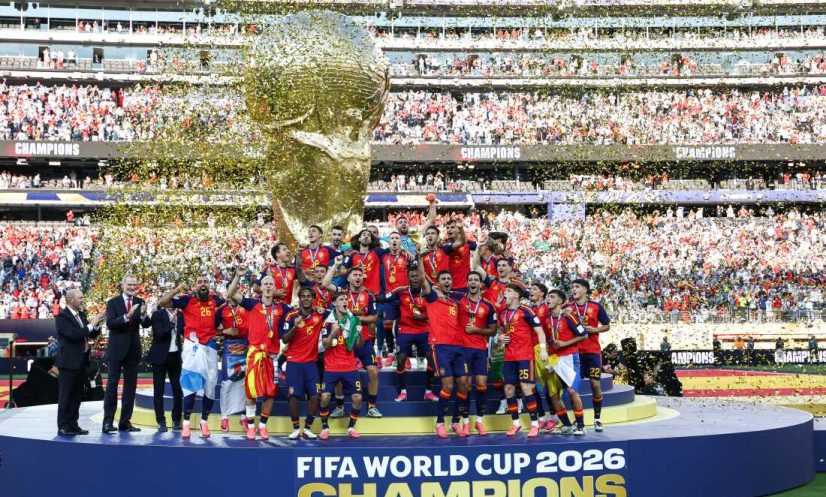
FIFA’s proposal to expand the FIFA World Cup to 64 teams for the 2030 centenary edition could effectively mark the end of the tournament being hosted by a single country, as the competition’s growing size would place unprecedented demands on infrastructure and logistics.
The governing body is considering increasing the number of participating teams from 48 to 64 after the conclusion of the 2026 World Cup. If approved, the expanded tournament would feature 128 matches, up from the 104 played in the current format.
Such an expansion would also require a significant increase in venues. The 48-team World Cup uses 15 stadiums to stage 104 matches across 12 groups. Applying the same ratio, a 64-team tournament would need around 20 stadiums to accommodate 16 groups and the enlarged knockout phase.
That scale would make it extremely difficult for a single nation to host the competition. Even football-rich countries with numerous large stadiums could struggle to provide enough suitable venues without disrupting domestic leagues.
For example, if England were selected as host, almost every Premier League club would likely have to make its stadium available throughout the tournament, alongside Wembley Stadium.
The trend towards joint hosting has already gathered momentum. The 2028 UEFA European Championship will be staged across the United Kingdom and Ireland, while the 2030 FIFA World Cup is set to be shared by Spain, Portugal and Morocco, with opening matches in Argentina, Uruguay and Paraguay to mark the tournament’s centenary.
Similarly, the 2032 UEFA European Championship will be co-hosted by Italy and Turkey.
However, Saudi Arabia is scheduled to host the 2034 FIFA World Cup on its own, despite concerns over whether a tournament of this size can be accommodated by a single nation. FIFA had previously explored expanding the 2022 World Cup in Qatar to 48 teams but concluded that the Gulf nation lacked the capacity to stage a larger competition without involving neighbouring countries.
A further increase to 64 teams would also reshape the qualification process. With FIFA currently having 211 member associations, a 64-team finals would allow roughly 30% of the world’s national teams to qualify.
Europe, which currently receives the largest share of World Cup places, would likely see its allocation rise significantly. If the existing qualification model were broadly maintained, UEFA could be awarded around 21 places, with all other continental confederations also expected to gain additional berths.
Supporters of expansion argue that a larger tournament would provide more opportunities for emerging football nations and boost the global appeal of the World Cup. Critics, however, warn that it could dilute the quality of the competition while creating major scheduling and logistical challenges.
FIFA is expected to discuss the proposal with its member associations in the coming months before making a decision on the format for the 2030 tournament.