Play store

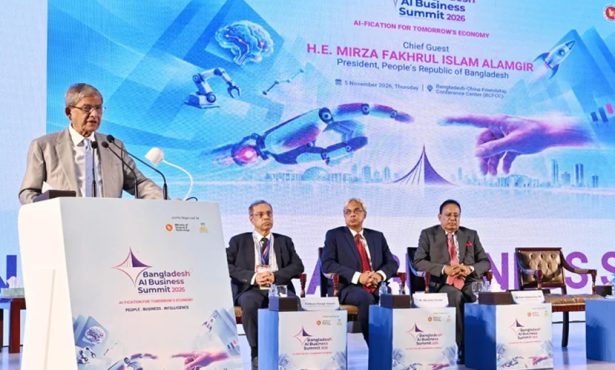
DHAKA: President Mirza Fakhrul Islam Alamgir on Thursday called for transforming Bangladesh into a country capable of developing and innovating artificial intelligence (AI) technologies rather than remaining merely a user of such technologies.
“Bangladesh must become an active participant in technological transformation, not a passive one. To achieve this, we need to build an AI-enabled, innovation-driven and human-centred Bangladesh rather than one that merely depends on AI,” he said.
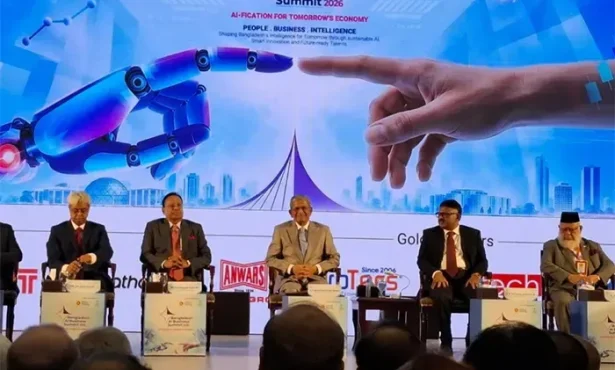
The President made the remarks while inaugurating the Bangladesh AI Business Summit 2026 at the Bangladesh-China Friendship Conference Centre in the capital.
He said Bangladesh was standing on the threshold of a major transformation, with artificial intelligence emerging as one of its key drivers. AI would play a crucial role in shaping the country’s agriculture, education, healthcare, industry, trade, employment and overall economy over the next decade, he added.
“Bangladesh’s position in the global arena will also depend largely on how effectively we harness this technology,” he said.
The President said AI was not merely a technology for future generations but could become one of the principal drivers of Bangladesh’s future development.
He stressed the need to strategically harness AI to boost productivity, modernise industries, expand exports, attract new investment and create decent employment opportunities for millions of young people.
Highlighting the country’s demographic advantage, Mirza Fakhrul said Bangladesh’s large young population was its greatest strength.
“If we can develop our young people into a technology-friendly and skilled workforce, they will become a major driving force behind the Fourth Industrial Revolution,” he said, stressing the importance of equipping them with sound education and technological skills to benefit from AI.
Citing international research, he said AI was expected to generate trillions of dollars in additional value for the global economy in the coming years, and Bangladesh should seize this opportunity.
He urged the business community not to view AI merely as a tool for cutting costs but also as a means of developing new products and services, entering new markets and creating fresh employment opportunities.
The President called on universities, the business community and the younger generation to work together to harness the potential of AI.
He said the technology could play a significant role in realising Bangladesh’s ambition of becoming a trillion-dollar economy by 2034 while addressing the challenges of graduating from the least developed country (LDC) category.
“Bangladesh’s readymade garment industry has earned the country global recognition. Similarly, if our young people can embrace AI technology with the necessary skills and capabilities, Bangladesh has the potential to establish a new identity in the global arena,” he said.
Highlighting government initiatives to ensure the responsible use of AI, the President said the government had already begun formulating a values-based national AI policy, focusing on ethics, human rights, risk-based regulation and responsible use.
He also said work had begun on developing national AI capabilities based on the Bangla language.
However, he noted that government initiatives alone would not be sufficient to achieve these goals, stressing the need for collective efforts involving businesses, researchers, universities and young entrepreneurs.
The President also cautioned against the potential risks of AI, particularly its possible impact on employment.
“At a time when a significant portion of our large population is educated but unemployed, we must seriously consider whether AI could create further unemployment,” he said.
He warned that despite its enormous potential, AI also carried significant risks and uncertainties.
“We must remain vigilant at every level to ensure that this technology does not assume control over everything. Ensuring the safe use and effective regulation of AI is essential. Otherwise, human civilisation could face an existential crisis,” he said.
The President further stressed the need to assess the sustainability and suitability of any technology before adopting it.
“We must be cautious about adopting technologies that may cause harm rather than benefit people. Technology becomes truly useful only when it contributes to human welfare and the advancement of civilisation,” he said.
He called for ensuring that AI technologies were adopted in line with Bangladesh’s political, economic and social realities.
Science and Technology Minister Fakir Mahbub Anam, Chairman of the Parliamentary Standing Committee on the Ministry of Science and Technology and lawmaker Ruhul Quddus Talukder Dulu, and International Chamber of Commerce Bangladesh President Mahbubur Rahman addressed the event as special guests.
Alamgir Hossain, chief executive officer of UK-based Readiness and Intelligent Systems Ltd and a former professor, delivered the keynote address.
The summit was jointly organised by the Ministry of Science and Technology and the Dhaka Chamber of Commerce and Industry (DCCI). DCCI President Taskin Ahmed delivered the welcome address, while Science and Technology Secretary Md Anwar Hossain also spoke on the occasion.