


 Play store

Dhaka: Bangladesh Information and Broadcasting Minister Zahir Uddin Swapan has described information management as the “oxygen” of governance, emphasizing that providing accurate information and preventing misinformation during disasters is an “acid test” for the government.
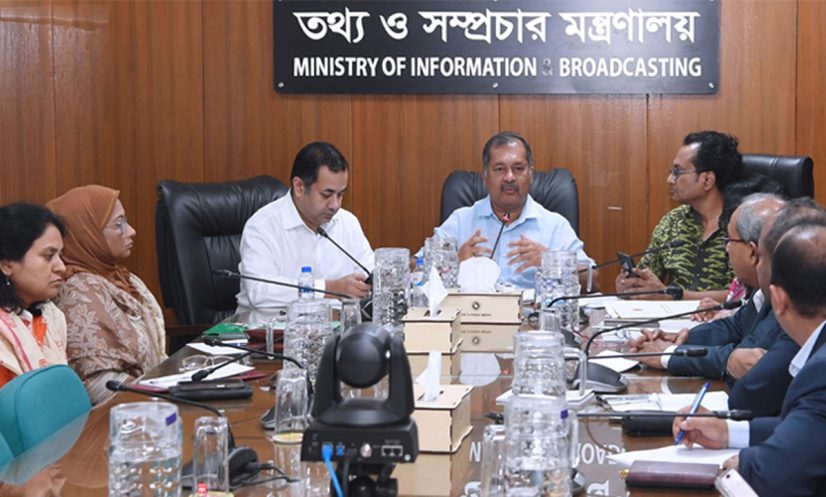
Speaking at a briefing with District Information Officers (DIOs) at the Ministry of Information and Broadcasting in Dhaka on Tuesday, the minister instructed officials to maintain direct communication with the public, present an accurate picture of the government’s disaster response, and provide daily updates on relief and recovery efforts.
District Information Officers from across the country joined the meeting virtually and shared their feedback on information management during the ongoing flood emergency.
The briefing was attended by State Minister for Information and Broadcasting Yaser Khan Chowdhury, the Prime Minister’s Information Adviser Dr. Jahed Ur Rahman, Ministry Secretary Mahbuba Farzana, Principal Information Officer Syed Abdal Ahmed, Director General of the Department of Mass Communication Md. M.A. Jalil, and other senior officials.
“Information management is like oxygen,” Swapan said. “Just as polluted air or a lack of oxygen threatens life, misinformation and disinformation can cause severe social disruption. Preventing the spread of false information is one of our foremost responsibilities. If we can identify and counter at least 20 pieces of misinformation every day and report that to the nation, people will become more aware and the ministry’s work will have greater impact.”
The minister noted that digital platforms have become a major source of information alongside traditional print and broadcast media. He urged officials to move beyond conventional communication methods and establish a stronger and more immediate presence across digital platforms.
During the briefing, Swapan spoke virtually with information officers from seven flood-affected districts—Chattogram, Cox’s Bazar, Rangamati, Khagrachhari, Bandarban, Habiganj, and Moulvibazar—to assess field-level operations.
He directed the Director General of the Department of Mass Communication to immediately form a Special Emergency Team comprising officers from these seven districts. The team will remain connected with ministry headquarters around the clock to facilitate rapid information exchange and coordination.
The minister instructed officials to submit objective, data-driven reports, including daily statistics on inundated villages, stranded residents, snakebite incidents, and relief distribution. He said the information would be cross-checked with data from the Ministry of Disaster Management and Relief to ensure accuracy.
To maintain continuous communication with the public during the disaster, the State Minister for Information and Broadcasting and the Prime Minister’s Information Adviser have been tasked with overseeing public outreach. The ministry will also hold daily press briefings on the flood situation and government relief efforts, while a centralized control room will coordinate information management.
“While the work of many ministries is visible through infrastructure and field operations, our responsibility is to keep people informed and reassured through accurate information across digital and media platforms,” Swapan said. “This disaster is an acid test for us.”
Officials participating virtually from the affected districts reported that they are continuing public awareness campaigns through loudspeaker announcements and community outreach. Their efforts focus on relocating people from landslide-prone areas to shelters, preventing waterborne diseases, raising awareness about snakebite risks, and ensuring transparency in relief distribution as flood conditions gradually improve.
Concluding the briefing, the minister called on field-level officials to continue carrying out their duties with professionalism and dedication despite the challenging conditions.