


 Play store

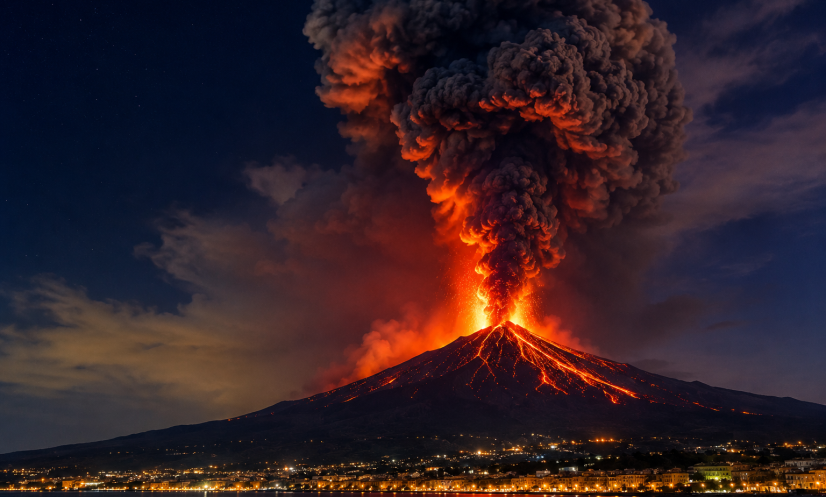
Mount Etna roared back to life this week, sending lava down its slopes and a towering cloud of ash above eastern Sicily, in the latest burst of activity from Europe’s most active volcano.
The renewed eruption followed more than three weeks of relative calm. Activity began early on Thursday, July 30, at around 3:30am local time, with intense Strombolian explosions from the summit area. The explosions later developed into a lava fountain, producing a dense column of ash visible from Catania and communities across the volcano’s eastern and southern flanks.
Reports circulating late on Friday said the eruption column rose as high as 7,000 metres above sea level as fresh explosions illuminated the night sky. Fiery lava flows could be seen cutting across the upper slopes, while a dark plume drifted over parts of the Sicilian coastline.
However, the strongest phase appeared to be easing by Friday, with local media reporting that lava output had slowed and volcanic tremor levels had fallen sharply. Such a decline often indicates that an eruptive episode is losing intensity, although scientists caution that conditions at Etna can change rapidly.
Italy’s National Institute of Geophysics and Volcanology, or INGV, closely monitors Etna through seismic instruments, satellite observations, thermal cameras and gas measurements. Scientists use changes in volcanic tremors, crater activity and the movement of magma to assess whether an eruption is intensifying or subsiding.
No injuries or immediate threat to populated areas were reported in connection with the latest activity. Lava from Etna’s summit eruptions generally remains within uninhabited areas at high altitude, but ash can create difficulties for nearby communities, affecting roads, crops and air quality.
Volcanic ash also poses a serious risk to aircraft because fine particles can damage jet engines and reduce visibility. Authorities were therefore monitoring the plume’s height and direction. There was no confirmed large-scale closure of Catania International Airport linked to the latest episode at the time of reporting, but passengers were advised to check flight information before travelling.
The airport, one of southern Italy’s busiest, experienced major disruption during another Etna eruption in early July. Operations were suspended after ash entered surrounding airspace, leading to about 120 flight cancellations and more than 60 diversions before services resumed following a downgrade of the volcanic alert.
Standing more than 3,300 metres above sea level, Etna dominates eastern Sicily and covers an area of roughly 1,200 square kilometres. Its eruptions frequently produce lava fountains, ash emissions and flows that reshape the summit area.
The latest spectacle again attracted attention from residents, tourists and photographers. Authorities nevertheless urged visitors to respect restrictions around the summit and follow instructions from civil protection officials, as sudden explosions and changing winds can make conditions hazardous even when nearby towns are not directly threatened.