


 Play store

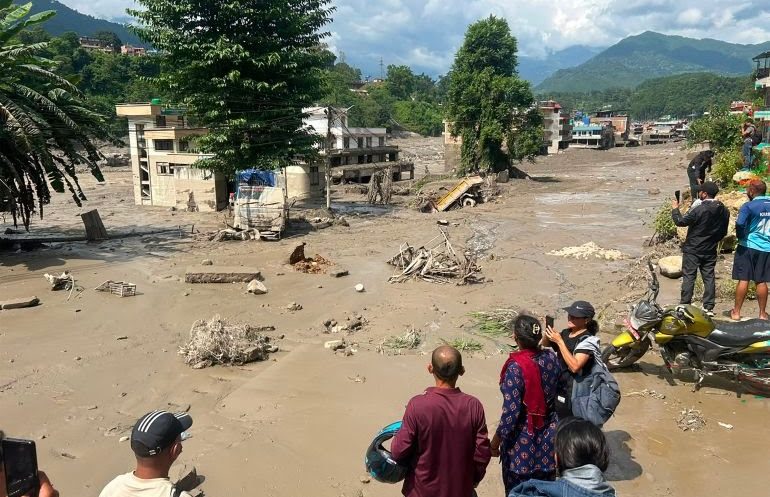
A massive landslide of mud and rock along the Nepal-China border triggered catastrophic flooding in Nepal on Wednesday, killing at least 98 people and leaving hundreds of tourists and local residents missing.
Verified videos showed people being swept away by torrents of mud and water near the border, as authorities on both sides warned of a potentially much higher death toll and extensive destruction.
Homes, roads and power projects were washed away in Nepal, while Chinese authorities reported major damage around Gyirong county in Tibet after a mudslide struck a border crossing.
Nepal’s Foreign Minister Shisir Khanal told parliament that an earthquake may have triggered an avalanche that caused the devastating floods, according to local media.
Security footage from the Chinese side showed people fleeing moments before a torrent of rock, mud and water engulfed buildings and vehicles near the Nepal-Tibet border.
The floodwaters descended from the mountainous area, prompting authorities in India’s northern states of Uttar Pradesh and Bihar to issue flood alerts as rivers carrying water from Nepal flowed towards the plains.

Authorities in Bihar said they had evacuated about 5,000 people from six districts and planned to move between 10,000 and 12,000 people to safer areas.
Nepal’s Tourism Ministry said at least 341 foreign travellers were missing, including more than 100 Indians, three US citizens and 12 British nationals. Dozens of Nepali residents were also reported missing.
Nepal police said rescue teams had recovered 95 bodies, while local media reported that 65 people were receiving treatment in hospitals in the affected area and Kathmandu.
South Korea separately said eight of its nationals working at a hydropower project were missing.
The precise cause of the disaster remained unclear. The German Research Centre for Geosciences said a magnitude 4.4 earthquake occurred about seven minutes before the time shown on security-camera footage from the area.
An initial analysis of Planet Labs satellite imagery indicated that a landslide involving snow and rock triggered a debris-laden flood in the Lhende River, about 20 kilometres northeast of the Rasuwagadhi border crossing, Nepal’s National Disaster Risk Reduction and Management Authority said.
Before-and-after satellite images appeared to show extensive destruction on both sides of the river’s normal course.
Qianggong Zhang, head of climate and environmental risks at the Kathmandu-based International Centre for Integrated Mountain Development, said the cause of the ice-rock avalanche into the Lhende Khola river had yet to be confirmed.
He warned that a second flood could occur because a blockage remained upstream in the river along the Nepal-China border.
Rescue helicopters were unable to land in Nepal’s affected areas of Syapru Besi and Timure in Rasuwa district because the river was flowing above its normal level, officials said.

Television footage showed collapsed houses, floating vehicles and a metal bridge being swept away by the floodwaters. Witnesses said entire settlements along the river had been engulfed.
“There could be heavy casualties or loss of property,” Rasuwa district administrator Narendra Pariyar said, urging people living along the Bhote Koshi river to move to higher ground.
“There is devastation everywhere we look,” said Tula Bahadur BK, a health worker in Rasuwa. He said settlements beside the river had been completely swept away and that five of his relatives were missing.
China’s official Xinhua news agency reported that the mudslide struck the Gyirong port, severing roads, communications and power links in the Shigatse region near the border.
Chinese state broadcaster CCTV said authorities had deployed 601 personnel and 113 vehicles, along with search dogs and rescue equipment, for emergency operations.
A rescuer interviewed by CCTV said teams had been unable to establish contact with the Gyirong border port. A preliminary drone inspection found that all roads leading to the crossing had been completely destroyed.
“The mudslide situation is indeed quite severe,” the rescuer said, adding that the mud was very thick and continuous rain could cause water levels to rise further.
Chinese President Xi Jinping ordered an all-out search for missing people and called for stronger monitoring and early-warning systems to prevent secondary disasters.
The Bhote Koshi originates in Tibet before flowing through Nepal, where it joins the Trishuli river and eventually enters India as the Gandak.
The region was hit by another deadly Bhote Koshi flood last year, which killed nine people and left 24 missing. The disaster also washed away the Friendship Bridge linking Nepal and China, disrupting trade and transport for months.
That flood was triggered by the drainage of a supraglacial lake in Tibet, according to a regional climate monitoring organisation.