


 Play store

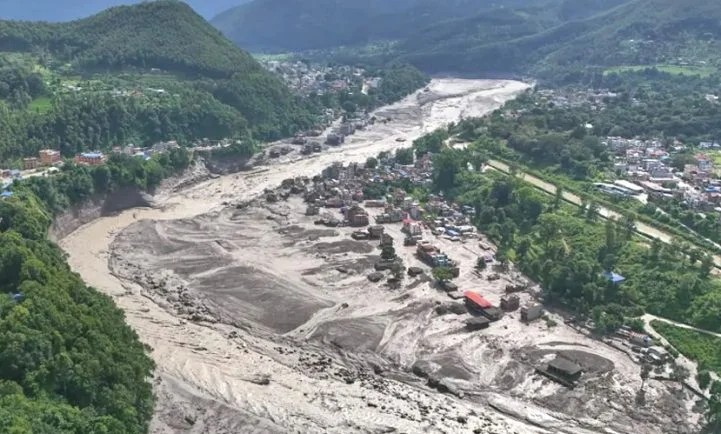
A glacier collapse triggered devastating flash floods and landslides along the Nepal-Tibet border, killing at least 162 people and leaving around 1,500 missing, according to officials and media reports.
The disaster began around 8:40am local time on Wednesday, August 26. Nepalese authorities said 826 people were missing in the country, including around 600 foreign tourists. Chinese state media reported another 558 people missing in Tibet’s Gyirong County, including 260 foreign nationals.
How the disaster unfolded
Experts said the disaster originated high in the Himalayas, where a large section of a glacier broke away at an altitude of around 5,200 metres.
Satellite imagery showed the ice mass plunging about 1,200 metres, gathering huge quantities of rocks and sediment before crashing into the Lende River near the Nepal-China border.
The debris temporarily formed a natural dam across the river. When the barrier broke, a massive surge of water, mud and debris swept downstream, triggering the devastating flash floods.
Initial reports suggested that a 4.4-magnitude earthquake had caused the glacier collapse. However, the US Geological Survey later said the seismic signal had been generated by the landslide itself, which was subsequently recorded as a magnitude 5.2 event.
Nepal and Tibet badly affected
Timure and Syaphrubesi in Nepal’s Rasuwa district were among the worst-hit areas. Water from the Lende Khola flowed into the Bhote Koshi and Trishuli rivers, with the Trishuli rising by nearly nine metres within just 30 minutes.
Floodwaters later spread into parts of Nuwakot and Dhading districts, damaging homes, roads and other infrastructure.
On the Tibetan side, mud and debris hit Gyirong Port in Gyirong County, where thick layers of sediment have hampered rescue efforts.
Foreign tourists among missing
Of the 826 people reported missing in Nepal, around 600 are foreign tourists. They include 177 Indians, 63 Americans, 34 Australians, 33 Britons and 25 Canadians.
In Tibet, 260 of the 558 missing people are foreign nationals. Many were travelling towards the Kailash-Mansarovar region when the disaster struck.
Tourism officials are working to establish the whereabouts of people travelling in different groups.
Rescue operations underway
More than 5,000 Nepalese soldiers and police officers have joined rescue operations. Helicopters, drones and trained dogs are being used to search for missing people, while helicopters are delivering tents, food and other emergency supplies to isolated communities.
At least 65 injured people are receiving treatment at local hospitals and facilities in Kathmandu. Many residents have been evacuated from affected areas by military helicopters.
Rescue operations remain difficult because roads have been destroyed, river levels remain high and thick layers of mud and debris have blocked access to several areas. Officials fear the death toll could rise.
Chinese authorities are also monitoring the situation in Tibet, where a lake upstream remains partially blocked and could pose another flood threat if the natural barrier collapses.
International assistance
India has sent a rescue aircraft carrying about 10 tonnes of emergency relief supplies to Nepal. The International Federation of Red Cross and Red Crescent Societies has provided 1 million Swiss francs in emergency funding to support the Nepal Red Cross’s relief and damage-assessment operations.
The United Nations has also deployed personnel to assist Nepal’s response, while the European Union has activated its Copernicus Emergency Management Service to monitor and map the affected areas using satellite imagery.
South Korea is preparing to send a rapid response team after several of its nationals were reported missing. The United States has announced $500,000 in assistance and plans to send a disaster-response expert to Nepal.