Play store

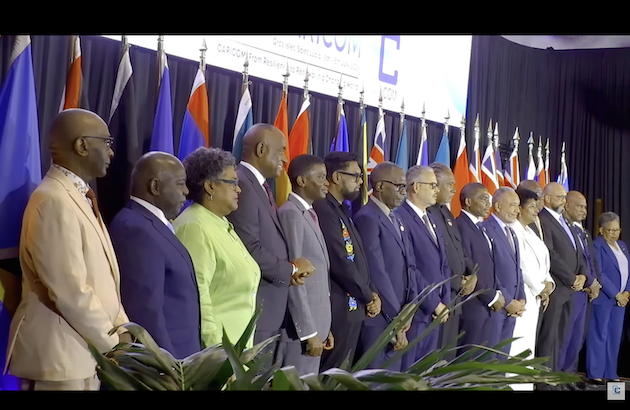
Caribbean leaders gathered in Saint Lucia on Tuesday for the annual summit of the Caribbean Community (CARICOM), facing a growing list of regional and global challenges that include rising living costs, climate change, food insecurity, crime, geopolitical tensions and economic uncertainty.
The 51st Regular Meeting of the Conference of Heads of Government of CARICOM, which runs through Wednesday, brings together leaders of the 15-member regional bloc to chart a common response to issues affecting the Caribbean and strengthen regional cooperation.
Discussions are expected to focus on regional security, climate resilience, economic integration, trade, migration, food and water security, transportation and the governance of emerging technologies such as artificial intelligence.
Saint Lucia’s Prime Minister Philip J. Pierre assumed CARICOM’s rotating six-month chairmanship at the opening session, describing the current global environment as one of “profound uncertainty” in which international crises are increasingly affecting the daily lives of Caribbean citizens. “Our people feel these pressures every day,” Pierre said, pointing to soaring food and energy prices, worsening climate impacts, and growing concerns over crime and public safety.
He said his chairmanship would focus on ensuring that regional integration produces tangible benefits for ordinary citizens rather than remaining confined to policy discussions and official declarations.
“Our people are asking a serious and legitimate question: What more can CARICOM do for me?” Pierre said. “We must make integration work for the ordinary citizen.”
Pierre outlined an ambitious agenda that includes accelerating implementation of the CARICOM Single Market and Economy (CSME), strengthening food and nutrition security, tackling violent crime and the illegal flow of firearms, expanding regional transportation links, improving access to climate finance and developing a coordinated Caribbean approach to artificial intelligence.
He also called for greater inclusion of young people, women, persons with disabilities and other traditionally underrepresented groups in regional development initiatives.
Climate change featured prominently in the opening session, with Pierre renewing CARICOM’s long-standing demand for climate justice. He argued that Caribbean nations contribute only a tiny fraction of global greenhouse gas emissions but continue to bear a disproportionate share of the consequences, including stronger hurricanes, rising sea levels, prolonged droughts and coastal erosion.
He urged the international community to increase access to climate finance, expand loss-and-damage funding and reform international financial systems to better address the vulnerabilities of small island developing states.
The summit comes as Caribbean governments continue to grapple with the economic fallout from global conflicts, supply chain disruptions and persistent inflation, while also preparing for another Atlantic hurricane season amid growing concerns over increasingly extreme weather events.
CARICOM Secretary-General Carla Barnett said the organisation’s founders envisioned regional integration as a practical response to external economic and political pressures, a vision that remains equally relevant today.
“Then, as now, external factors and influences put at risk the vision of regional integration,” Barnett said, urging member states to accelerate implementation of long-standing regional commitments, particularly under the CARICOM Single Market and Economy.
She highlighted progress in expanding the free movement of skilled workers, boosting regional agricultural production and strengthening international partnerships, but acknowledged that significant work remains to fully implement agreed regional initiatives.
Outgoing CARICOM Chairman and Prime Minister of St Kitts and Nevis Terrance Drew said his tenure underscored the importance of unity in addressing shared regional challenges. “The question is no longer whether CARICOM will survive,” Drew said. “The question now is how we strengthen CARICOM for the next generation.”
He noted that member states had continued to cooperate on food security, climate resilience, regional security, Haiti, reparatory justice and international diplomacy despite mounting external pressures.
Founded under the Treaty of Chaguaramas on July 4, 1973, CARICOM promotes economic integration, coordinated foreign policy and functional cooperation among its member states. Today, the organisation comprises 15 member states and seven associate members and works across a broad range of areas, including trade, agriculture, education, health, security, transportation, climate change and sustainable development.
Held under the theme “People, Partnerships, Prosperity: Promoting a Secure and Sustainable Future,” this year’s summit is expected to conclude on Wednesday with a final communiqué outlining decisions and policy directions on regional security, climate resilience, economic integration and other strategic priorities aimed at strengthening the Caribbean’s collective response to an increasingly uncertain global landscape.