


 Play store

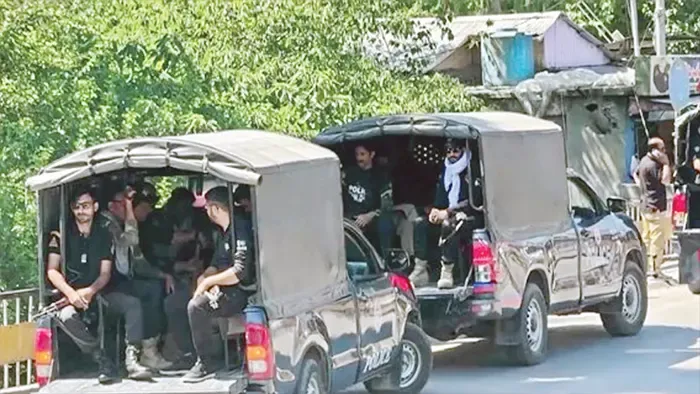
Political tensions are escalating rapidly in Pakistan-administered Jammu and Kashmir (PoK), raising concerns of a major confrontation ahead of the region’s upcoming elections.
The Jammu and Kashmir Joint Awami Action Committee (JAAC) has issued a 48-hour ultimatum to Islamabad, warning of a “final and largest” movement if its 38-point charter of demands is not met.
The growing crisis is closely linked to the regional elections scheduled for July 27. While the submission of nomination papers was set to begin on June 9, JAAC has instead announced a massive protest march towards Muzaffarabad.
Analysts warn that the unfolding situation could turn into one of the most significant political flashpoints in recent years.
At the centre of the unrest lies a controversial demand—the abolition of 12 legislative seats reserved for Kashmiri refugees living in Pakistan.
JAAC argues that these reserved seats enable Islamabad to maintain disproportionate influence over PoK’s political system.
According to available data, approximately 436,000 voters are registered for these 12 seats, whereas around 3.3 million voters elect representatives to the remaining 33 general seats.
Critics contend that this imbalance gives refugee votes significantly greater weight than those of local residents.
However, on June 7, the PoK Supreme Court ruled that these seats are constitutionally protected and cannot be abolished without a formal constitutional amendment.
Beyond political demands, JAAC’s 38-point agenda reflects deep-rooted economic frustrations.
The organisation has called for a review of hydropower agreements, increased subsidies on essential goods such as flour, and reductions in electricity tariffs.
Protesters argue that it is unjust for residents to pay high prices for electricity generated within their own region. They also accuse the central authorities of long-standing economic neglect and political marginalisation.
Formed in 2023, JAAC has quickly emerged as a powerful grassroots movement advocating civil rights.
In May 2024, it led widespread protests against inflation and demanded subsidies comparable to those in Gilgit-Baltistan.
These demonstrations, which included strikes and road blockades, brought large parts of PoK to a standstill. Another major protest movement followed in September 2025, further strengthening the group’s influence.
Although Pakistan refers to the region as “Azad Kashmir,” questions over its autonomy persist. Under Pakistan’s Constitution, PoK is not a province and lacks representation in the national parliament.
While the region has its own president, prime minister, judiciary, and legislative assembly, key decision-making powers remain concentrated in Islamabad-controlled bodies, particularly the Kashmir Council led by Pakistan’s prime minister.
Additionally, PoK’s constitutional framework restricts political participation by barring individuals or parties that oppose accession to Pakistan. Candidates are required to formally pledge support for integration with the country.
Despite being rich in natural resources—including forests, minerals, gemstones, and extensive water reserves—PoK remains underdeveloped.
The region supplies nearly 70 percent of irrigation water to Pakistan’s Punjab and Sindh provinces and contributes 10 to 15 percent of the country’s electricity through hydropower.
However, residents claim that most of the revenue generated from these resources is directed to mainland Pakistan, while local infrastructure and public services remain inadequate.
Socio-economic indicators reveal a troubling reality. A 2025 study published in Nature found that while 66 percent of the population depends on agriculture and livestock, 57.1 percent suffer from food insecurity. Nearly 29 percent are affected by malnutrition—significantly higher than the national average.
In mountainous areas, around 90 percent of households face food shortages. According to official data, 39 percent of children under five suffer from stunting, and maternal mortality stands at 104 deaths per 100,000 live births.
The political unrest is unfolding amid deteriorating security conditions. Political activist Amjad Mirza has alleged that more than 600 protesters have been arrested and over 100 killed in recent crackdowns, although these claims remain independently unverified.
A 2026 report by the European Union’s asylum agency recorded at least 56 deaths in 39 security-related incidents across PoK and Gilgit-Baltistan between November 2024 and April 2026.
Meanwhile, the Pakistan Institute for Conflict and Security Studies (PICSS) reported 1,045 terrorist attacks across Pakistan in 2025, resulting in 1,139 deaths—the highest in a decade—largely attributed to the resurgence of Tehreek-e-Taliban Pakistan (TTP).
India maintains its long-standing position that the entire Jammu and Kashmir region legally acceded to it on October 26, 1947, when Maharaja Hari Singh signed the Instrument of Accession.
New Delhi argues that Pakistan’s subsequent military intervention triggered the first Indo-Pak war.
In 1994, both houses of India’s Parliament unanimously passed a resolution declaring the entire region an integral part of India and calling on Pakistan to vacate territories under its control.
As the July elections draw closer, JAAC’s threat of large-scale protests has added a new layer of uncertainty.
Observers warn that PoK may once again be heading towards a major political confrontation, with potential consequences not only for the region but for broader South Asian stability.