Play store

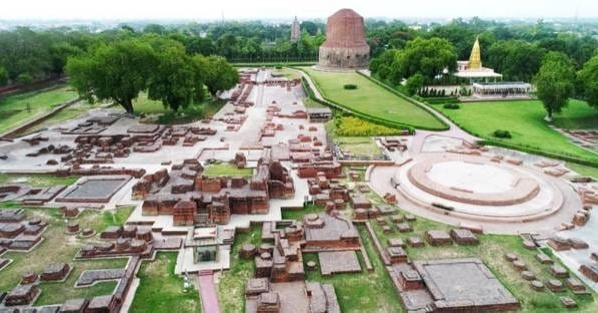
The ancient Buddhist site of Sarnath has been inscribed on the UNESCO World Heritage List, becoming India’s 45th World Heritage property.
The decision was taken at the 48th Session of the World Heritage Committee in Busan, South Korea, where India’s official nomination for the 2025–26 cycle, the “Ancient Buddhist Site of Sarnath,” received approval.
Indian Prime Minister Narendra Modi, Union Culture Minister Gajendra Singh Shekhawat and Uttar Pradesh Chief Minister Yogi Adityanath welcomed the historic recognition and congratulated the people of India, according to the Press Information Bureau.
The UNESCO inscription recognises Sarnath’s exceptional cultural, archaeological and spiritual significance and highlights its enduring contribution to Buddhist history and civilisation.
The serial property comprises two component sites—the Chaukhandi Stupa and the Archaeological Remains of Sarnath, including the Dhamekh Stupa, Dharmarajika Stupa, Mulagandhakuti Vihara and the Ashokan Pillar.
Known in Buddhist tradition as Rishipatana, Ishipatana and Mrigadava, Sarnath is regarded as the place where the Buddha delivered his first sermon in the 6th century BCE. Known as the “Turning of the Wheel of the Law” (Dharmachakra Pravartana), the event marked the beginning of the Buddhist Sangha and the teaching of the Noble Eightfold Path.
The site preserves a remarkable archaeological record spanning nearly 16 centuries, from the pre-Mauryan period in the 5th–4th centuries BCE to the 12th century CE, with later additions.
It has been extensively excavated by the Archaeological Survey of India.
With Sarnath’s inscription, three of the four principal Buddhist pilgrimage sites—Lumbini in Nepal, the Mahabodhi Temple at Bodh Gaya in Bihar and Sarnath in Uttar Pradesh—are now included on the UNESCO World Heritage List.
Sarnath joins other internationally recognised Buddhist heritage sites, including Sanchi, Nalanda and Ajanta in India; Anuradhapura in Sri Lanka; Paharpur in Bangladesh; and Taxila and Takht-i-Bahi in present-day Pakistan.
Sarnath was first included on India’s Tentative List of World Heritage Sites in 1998. India submitted its nomination to the World Heritage Committee in January 2025, followed by an 18-month evaluation process that included technical meetings and an ICOMOS mission to assess the site.
The nomination was made under UNESCO criteria (iii) and (vi). Criterion (iii) recognises Sarnath as one of the four principal destinations of Buddhist pilgrimage, reflected in the numerous religious buildings and monuments constructed and rebuilt there over the centuries. Criterion (vi) acknowledges its direct and tangible association with events of outstanding universal significance in the life of the Buddha—most notably his first sermon and his meeting with his first disciples.
The inscription also places renewed emphasis on protecting Sarnath’s Outstanding Universal Value through sustainable tourism management and by preventing unplanned development in its buffer zone, ensuring the preservation of the site’s authenticity and integrity.