Play store

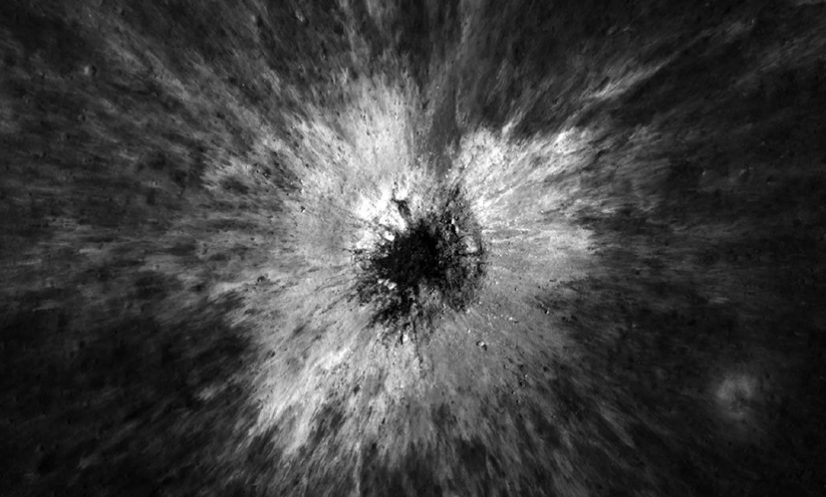
NASA scientists have discovered the largest newly formed impact crater ever identified in the solar system after a routine check of lunar images revealed an unusual bright patch on the Moon.
Robert Wagner, an image-processing specialist with Intuitive Machines who works with NASA’s Lunar Reconnaissance Orbiter Camera (LROC), spotted the feature while examining a global lunar map on Oct. 24, 2025.
By comparing images taken before and after the feature appeared, Wagner determined that it was a newly formed crater. Scientists reported the discovery on Sept. 16 in Science Advances.
Named McGetchin after pioneering lunar scientist Tom McGetchin, the crater formed on the Moon’s eastern edge sometime between April 11 and May 22, 2024. An asteroid or comet estimated to have been roughly the size of a three- to six-storey building struck the surface, creating a crater about 728 feet (222 metres) wide and 141 feet (43 metres) deep.
Scientists estimate that an impact of this size occurs on the Moon roughly once every century or even less frequently.
The discovery highlights the value of NASA’s Lunar Reconnaissance Orbiter, which has been circling the Moon since 2009. Its instruments allow scientists to monitor changes across the lunar surface and identify newly formed craters and other geological features.
After the crater was detected, researchers used LRO’s Narrow-Angle Camera to obtain much sharper images and determine its size and shape. The camera can capture details at roughly three feet per pixel.
Impact leaves a four-mile cold spot
The discovery also revealed that the impact changed the lunar surface well beyond the crater itself.
Scientists using LRO’s Diviner thermal instrument found a four-mile-wide area around McGetchin that is about 16 degrees Fahrenheit (9 degrees Celsius) colder at night than the surrounding terrain.
Researchers say the impact loosened and “fluffed up” the lunar soil, or regolith, making it less dense and reducing its ability to retain heat after sunset. The finding was reported in a second Science Advances paper.
The large cold region suggests that an impact can modify the Moon’s surface far beyond the visible crater. Such changes could be relevant to future lunar exploration because variations in soil texture and density may affect how rover wheels move across the surface.
NASA’s LRO carries seven scientific instruments and has spent more than 17 years mapping the Moon. Its long-term observations allow scientists to detect changes that would otherwise be difficult to identify from a single snapshot of the lunar surface.