Play store

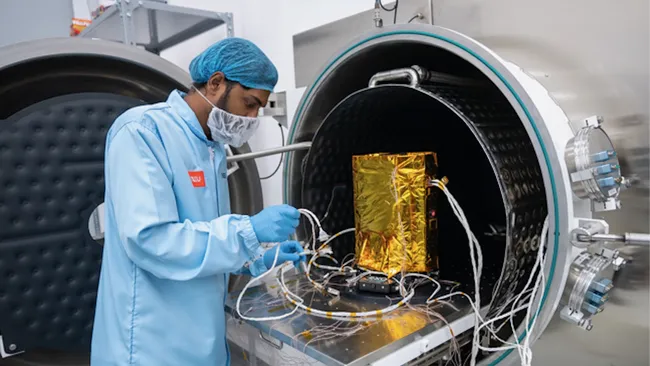
The United Arab Emirates (UAE) has unveiled a half-scale model of a robotic probe designed to land on a distant asteroid as part of an ambitious eight-year mission to explore seven asteroids between Mars and Jupiter.
The Emirates Mission to the Asteroid Belt (EMA) is scheduled to launch from Japan in March 2028 aboard the main spacecraft MBR Explorer, developed by the UAE Space Agency. The mission will culminate in 2036 with an attempted landing on the unusually red asteroid 269 Justitia.
The Technology Innovation Institute (TII), which designed, built and tested the lander, presented the model at a press conference in Abu Dhabi on October 1. The flight-ready probe is being stored in a vacuum chamber before being transported to Colorado for integration with the main spacecraft.
The mission marks a major step in the UAE’s efforts to expand its deep-space exploration capabilities, following the success of its Hope Mars orbiter, which has been studying the Red Planet since 2021.
During its journey, the MBR Explorer will travel about five billion kilometres, conducting high-speed flybys of six asteroids before reaching 269 Justitia. The spacecraft will use gravitational assistance from Venus, Earth and Mars to navigate through the asteroid belt.
The six initial targets are 10253 Westerwald, 623 Chimaera, 13294 Rockox, 88055 Ghaf, 23871 Ousha and 59980 Moza.
Scientists are particularly interested in 269 Justitia, an asteroid about 50 kilometres wide whose distinctive reddish colour resembles that of icy objects in the distant Kuiper Belt beyond Neptune.
The unusual colour has prompted scientists to suggest that the asteroid may have originated in the outer solar system before migrating inward during its early history.
Studying the asteroid could provide insights into the distribution of water-bearing minerals and organic compounds during the formation of the solar system, said Elias Tsoutsanis, a chief researcher at TII’s propulsion and space research centre.
The MBR Explorer is expected to spend about seven months studying the asteroid from orbit before releasing the lander. The probe will descend towards the surface over two to three hours, depending on the asteroid’s still-unknown gravitational strength.
However, the lander is not expected to survive the touchdown. Travelling at an estimated speed of 15 to 27 metres per second, it will effectively perform a controlled impact rather than a conventional soft landing.
Researchers expect the impact to create a small crater, potentially exposing subsurface material that cannot be examined through orbital observations alone. Two onboard cameras will capture images during the final descent.
If the probe survives the impact, its battery will support operations for an estimated 20 to 50 minutes, allowing it to transmit close-up images to Earth.
The mission faces a narrow launch window of approximately three weeks beginning in early March 2028. Missing the opportunity could delay a comparable mission for at least a century because of the complex orbital requirements.
The lander will also have to operate autonomously throughout its journey, making decisions without commands from Earth or the main spacecraft. Equipped with artificial intelligence, it will determine when to capture images and prioritise the most valuable data for transmission.
The project has been developed in less than two years by a team of about 50 Emirati engineers and scientists, according to mission officials.
The UAE hopes the programme will strengthen its domestic space industry and help it become one of the world’s 10 largest space economies by 2031. Officials have not disclosed the mission’s overall cost.
By the time the spacecraft reaches its final destination in 2036, the technologies developed during the journey are expected to suppo