Play store

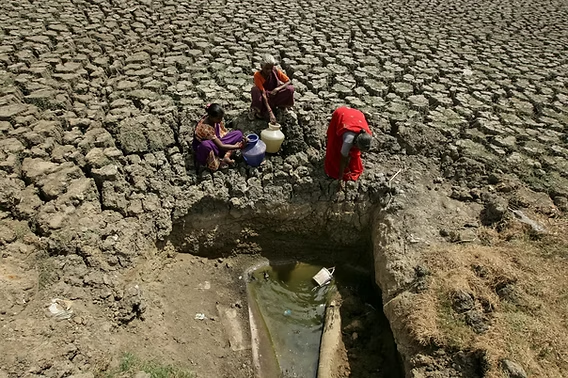
Extreme heat is emerging as one of the biggest threats to South Asia’s economic future, with the region projected to lose nearly 7 percent of its gross domestic product (GDP) by 2050 if urgent adaptation measures are not taken, according to a new World Bank report.
The report, A Liveable Future: Protecting Jobs and Growth from Extreme Heat in South Asia’s Cities, warns that rising temperatures are already taking a heavy toll on workers and businesses, costing the region the equivalent of 31 million full-time jobs every year through reduced labor productivity.
With South Asia expected to add around 280 million working-age people by 2050, the World Bank says intensifying heat poses a serious risk to employment, productivity and long-term economic growth.
The report projects that by 2070, about 520 million people across South Asia could experience at least one month of dangerous heat annually—four times the number affected today.
According to the study, extreme heat is disrupting businesses, reducing industrial output, straining health systems and damaging critical infrastructure. Low-income households, informal workers, women, children and the elderly are among the most vulnerable to its impacts.
“South Asia’s cities are central to the region’s future, but rising temperatures are putting jobs, livelihoods and economic growth at risk,” said Johannes Zutt, the World Bank’s Vice President for South Asia.
He stressed that building heat-resilient cities is not only about protecting people from extreme temperatures but also about safeguarding jobs, improving productivity, attracting investment and sustaining economic growth.
The report argues that extreme heat should no longer be treated as a seasonal emergency but instead be integrated into urban planning, infrastructure development and economic policymaking. It recommends expanding heat-resilient infrastructure, strengthening Heat Action Plans, protecting vulnerable workers, improving early warning systems, promoting sustainable cooling technologies and increasing both public and private investment.
John Warburton, Climate Resilience Lead for Asia Pacific at the UK’s Foreign, Commonwealth and Development Office (FCDO), described extreme heat as a growing development crisis that is destroying livelihoods, harming public health and pushing vulnerable communities deeper into poverty.
The report highlights that many practical solutions already exist. Several South Asian cities have demonstrated that measures such as urban greening, resilient infrastructure, efficient cooling systems and effective heat action plans can reduce economic losses while protecting lives and livelihoods.
Prepared with support from the UK government’s Climate Action for a Resilient Asia (CARA) programme, the World Bank’s Global Facility for Disaster Reduction and Recovery (GFDRR), and the City Resilience Program (CRP), the report concludes that investing in heat resilience today will be essential to ensuring South Asia’s cities remain engines of jobs, innovation and sustainable economic growth in the decades ahead.