Play store


Bangladesh suffered an estimated $1.3 billion to $1.8 billion in economic losses in 2024 as extreme heat reduced labour productivity, according to a new World Bank report.
The report warns that rising temperatures could significantly undermine the country’s economic growth and employment in the coming decades.
The report, “A Livable Future: Protecting Jobs and Growth from Extreme Heat in South Asia’s Cities,” released on July 29, estimates the losses at 0.3% to 0.4% of Bangladesh’s Gross Domestic Product (GDP).
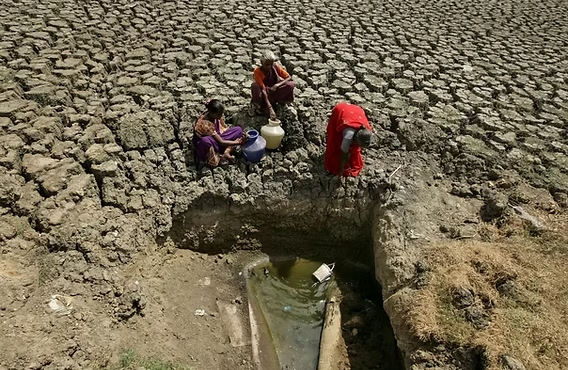
It notes that productivity declines sharply when temperatures exceed 37 degrees Celsius, making outdoor and even some indoor work increasingly difficult.
The World Bank identified Dhaka as the country’s most heat-affected city. Extreme temperatures are already making nearly 3% of annual working hours in the capital unproductive, equivalent to the loss of around 465,000 full-time jobs every year. If current trends continue, the report projects that Dhaka could lose 7.4% of its productive working hours by 2080.
The report also highlights a growing threat to Bangladesh’s ready-made garment (RMG) industry, one of the country’s largest export earners.
Citing a joint analysis by the International Labour Organization (ILO), International Finance Corporation (IFC), and Cornell University’s Global Labor Institute, the report estimates that the apparel industries of Bangladesh, Pakistan, Vietnam and Cambodia could collectively lose up to $65.8 billion in export earnings by 2030 if heat stress is not effectively addressed.
Beyond economic losses, the report warns of growing social risks. Excessive heat is reducing the productivity of female garment workers, making it harder for them to meet production targets and increasing their vulnerability to workplace violence and abuse.
However, the World Bank says the outlook can still improve through targeted investments. It pointed to Bangladesh’s Green Transformation Fund, launched in 2016 to help garment factories invest in energy- and water-efficient technologies and improve working conditions. The initiative has expanded from supporting a handful of factories to driving sector-wide improvements. Supported by the IFC’s Partnership for Cleaner Textile and sustainable financing, Bangladesh had more than 270 LEED-certified garment factories by the end of 2025.
Across South Asia, the report estimates that extreme heat is already causing productivity losses equivalent to 31 million full-time jobs each year and could shrink the regional economy by around 7% by 2050. By 2070, about 520 million people in the region are expected to experience dangerously high temperatures for at least one month annually, while heatwave-related deaths have risen sharply, including a doubling in Bangladesh and India since 2000.
World Bank South Asia Vice President Johannes Zutt said building heat-resilient cities is essential not only to protect lives but also to safeguard jobs, boost productivity, attract investment and sustain long-term economic growth. He stressed that timely action could help countries build more competitive, sustainable and liveable cities for future generations.