Play store


Ahmadul Kobir, Malaysia: Malaysia has called on ASEAN member states to move beyond agreements and declarations and take concrete action against transnational crime, urging faster information sharing, coordinated investigations and more effective enforcement operations to tackle cybercrime, online scams, money laundering, human trafficking and threats of violence and extremism.
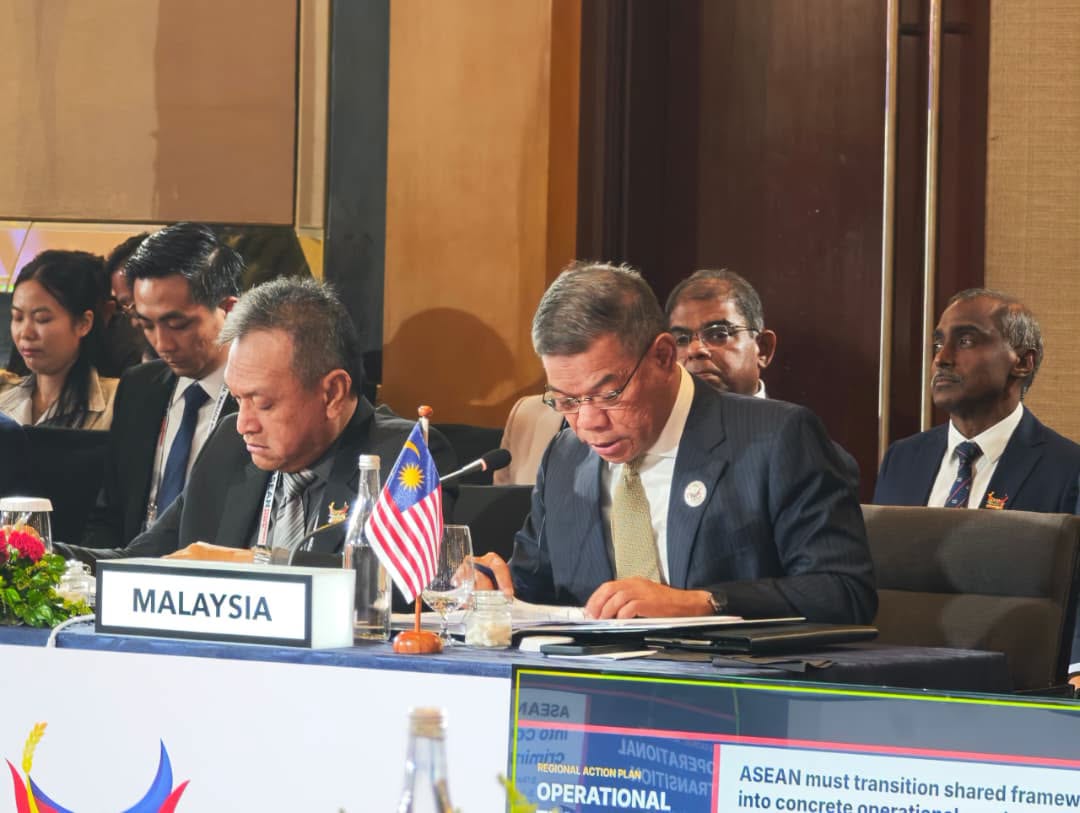
The call was made in Malaysia’s national statement at the 20th ASEAN Ministerial Meeting on Transnational Crime (AMMTC-20), held in Manila, the capital of the Philippines, on October 20.
Malaysian Home Minister Datuk Seri Saifuddin Nasution Ismail said transnational crime was becoming increasingly complex as criminal syndicates exploited digital technologies and artificial intelligence (AI) to expand their operations and make them more sophisticated.
No country could effectively combat such crimes on its own, he said, stressing that stronger regional and international cooperation was essential to address threats that crossed national borders.
Highlighting Malaysia’s efforts to tackle cybercrime and online fraud, Saifuddin said the country had launched the National Scam Response Centre (NSRC) in March 2026. Operating round the clock through the 997 hotline, the centre brings together law enforcement agencies, financial institutions and relevant authorities to speed up the detection and freezing of funds linked to fraudulent activities.
Malaysia also strengthened its legal framework against cyber threats, with both houses of Parliament passing the Cybercrime Bill 2026 in July to replace the Computer Crimes Act 1997.
The Malaysian statement highlighted the growing gap between the speed at which criminal proceeds could be moved across borders and the time required for investigations and legal proceedings.
Funds linked to criminal activities could be transferred internationally within minutes, while tracing transactions, gathering evidence and pursuing legal action often took considerably longer. Countries therefore needed to cooperate promptly to identify illicit funds, preserve digital evidence and coordinate investigations, it said.
Malaysia also called for stronger regulatory frameworks and enforcement capabilities to combat money laundering, particularly the proceeds of organised crime and online fraud.
According to the statement, a joint assessment report by the Financial Action Task Force (FATF) and the Asia/Pacific Group, published in December 2025, placed Malaysia under Regular Follow-Up status, reflecting progress in its legal, financial, domestic coordination and intelligence-related frameworks.
In April 2026, Malaysia hosted the inaugural meeting of the ASEAN Working Group on Illicit Money Laundering in Kuala Lumpur. As a Voluntary Lead Shepherd in this area, the country reaffirmed its commitment to promoting information exchange, capacity building and closer cooperation among ASEAN members.
Human smuggling and other crimes associated with irregular migration also featured in Malaysia’s regional security priorities.
The country said it was continuing to strengthen border management to prevent transnational criminal syndicates from exploiting irregular migration routes. Initiatives highlighted in the statement included the Malaysia Declaration on Border Control, the ASEAN Action Plan 2026–2035 and the Melaka Declaration.
However, Malaysia stressed that the central challenge was no longer simply establishing frameworks or securing commitments, but ensuring that they produced measurable results on the ground.
The country outlined three priorities for ASEAN: strengthening border controls to combat online scams and illicit financial flows; improving investigative capabilities, particularly the collection and preservation of digital evidence; and expanding operational cooperation among member states and international partners.
Malaysia emphasised that the effectiveness of ASEAN’s efforts against transnational crime should not be judged solely by the number of agreements, declarations or meetings held.
Instead, progress should be measured by tangible outcomes, including the number of criminal syndicates dismantled, victims protected and offenders brought to justice.
The statement also stressed that regional cooperation must deliver practical improvements in public safety rather than remain confined to formal commitments.
Malaysia reaffirmed its readiness to work actively with ASEAN member states and international partners to strengthen collective efforts against transnational crime and build a safer, more secure and resilient region.