Play store

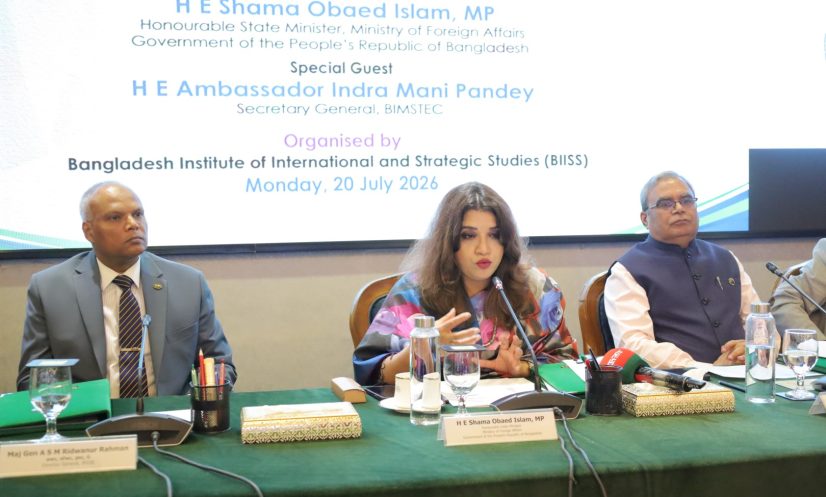
Staff Correspondent: State Minister for Foreign Affairs Shama Obaed Islam on Monday called for accelerating the implementation of regional connectivity initiatives under BIMSTEC, saying transport, energy and digital links must remain at the heart of the organisation’s vision for shared prosperity.
“Connectivity must remain the flagship of our regional ambition. The BIMSTEC Master Plan for Transport Connectivity provides the blueprint. The challenge now is implementation,” she said while addressing a seminar in Dhaka.
The Bangladesh Institute of International and Strategic Studies (BIISS) organised the seminar, titled “Three Decades of BIMSTEC: Advancing Regional Cooperation for Shared Prosperity,” at its auditorium to mark Bangladesh’s current chairmanship of the Bay of Bengal Initiative for Multi-Sectoral Technical and Economic Cooperation (BIMSTEC).
Shama Obaed said Bangladesh would continue supporting progress on regional transport networks, the proposed coastal shipping agreement and deeper cooperation in energy and digital connectivity to unlock the region’s economic potential.
She stressed that achieving the organisation’s connectivity goals would require stronger institutional coordination, innovative financing, active engagement of development partners and the private sector, and sustained political commitment from all member states.
The State Minister also highlighted the importance of addressing shared regional challenges, including terrorism, violent extremism, human trafficking, drug trafficking, cyber threats, illegal fishing, climate-induced disasters and humanitarian crises.
She called for deeper cooperation in maritime security, law enforcement, disaster risk reduction, humanitarian assistance and capacity building, saying regional prosperity could only be sustained in an environment of peace, security and resilience.
Referring to the Rohingya crisis, Shama Obaed said Bangladesh continued to shoulder a heavy humanitarian burden and expressed hope that BIMSTEC members would help generate stronger international support for the safe, voluntary and dignified repatriation of displaced Rohingyas to Myanmar.
“Climate resilience and disaster preparedness must remain at the heart of our agenda because few countries understand the human and economic cost of a warming planet more intimately than Bangladesh,” she said.
Reaffirming Bangladesh’s commitment as the current BIMSTEC chair, she said the country would work closely with Bhutan, India, Myanmar, Nepal, Sri Lanka and Thailand, as well as the BIMSTEC Secretariat, to strengthen the organisation’s institutional capacity, fully operationalise the BIMSTEC Charter and translate leaders’ commitments into tangible outcomes.
She also underscored the importance of expanding economic integration, trade, investment, the blue economy and people-to-people connectivity.
“The fisheries, shipping, renewable energy and marine resources of the Bay of Bengal are a shared inheritance that must be developed responsibly and managed sustainably,” she said, adding that Bangladesh would support scientific research, capacity building and practical cooperation to ensure inclusive and sustainable growth.
The State Minister further emphasised the need to invest in human capital through greater engagement of students, researchers, entrepreneurs, professionals, media representatives and cultural practitioners.
“We have the political commitment. Let us work together with renewed purpose and confidence. Let us transform BIMSTEC from a forum of great promise into a platform of effective regional cooperation,” she said.
BIMSTEC Secretary General Indra Mani Pandey, speaking as the special guest, outlined the organisation’s ongoing initiatives in areas including women’s empowerment, climate adaptation, energy cooperation, maritime security, cybersecurity, counterterrorism, tourism, visa facilitation, trade and investment.
BIISS Director General Major General A S M Ridwanur Rahman delivered the welcome address, while Dr Mahfuz Kabir, Research Director of BIISS, presented the keynote paper.
Panel discussions by academics and policy experts reviewed BIMSTEC’s three-decade journey, highlighting the need to strengthen institutional capacity, improve regional connectivity, expand economic cooperation and promote practical, action-oriented initiatives to foster peace, stability and sustainable development across the Bay of Bengal region.
Senior government officials, diplomats, representatives of BIMSTEC member states and international organisations, academics, researchers, development partners, private sector leaders and media representatives attended the seminar.