Play store

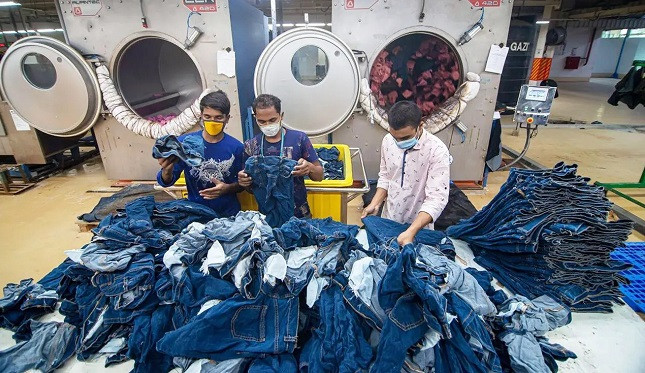
Bangladesh maintained its position as the European Union’s (EU) largest denim supplier in January-August 2026, despite a decline in shipments, as exports rebounded strongly in August, according to Eurostat dataBangladesh’s denim exports to the EU rose 12.71 per cent year-on-year to €134.08 million in August, up from €118.96 million a year earlier.
The growth outpaced the overall market, with the EU’s total denim imports from the world increasing 11.23 per cent to €430.16 million during the month.
Bangladesh accounted for around 31.2 per cent of the EU’s denim imports in August, compared with 30.8 per cent a year earlier.
However, shipments during the first eight months of the year fell 5.85 per cent to €869.13 million from €923.11 million in the same period last year, a decline of nearly €54 million.
The contraction was steeper than the 4.40 per cent fall in the EU’s total denim imports, which stood at €2.96 billion in January-August.
Consequently, Bangladesh’s market share slipped to 29.40 per cent from around 29.9 per cent a year earlier. Still, it remained well ahead of its nearest competitor, Pakistan, by nearly €344 million.
Pakistan, the second-largest denim supplier, recorded 14.99 per cent growth in August exports to €87.71 million. Its shipments during the January-August period, however, declined 7.88 per cent to €525.49 million, giving it a 17.78 per cent market share.
Turkey, the third-largest supplier, faced a sharper setback, with exports falling 13.26 per cent to €58.84 million in August and 21.08 per cent to €438.25 million in the first eight months, accounting for 14.82 per cent of the market.
Other major suppliers also recorded declines. Tunisia’s eight-month exports dropped 6.44 per cent to €219.94 million, while Cambodia’s fell 6.47 per cent to €144.83 million. Morocco’s shipments declined 14.48 per cent to €63.87 million.
Egypt emerged as a strong performer, with exports surging 59.57 per cent year-on-year to €30.67 million in August and 31.46 per cent to €188.14 million in January-August, securing a 6.36 per cent market share.
China’s shipments increased 17.70 per cent to €197.13 million over the eight months, accounting for 6.67 per cent of the market.
Vietnam and India also posted notable growth, with their eight-month exports rising 45.38 per cent to €53.98 million and 18.62 per cent to €31.40 million respectively.
Competitive strength
Talking to BSS, former Bangladesh Garment Manufacturers and Exporters Association (BGMEA) director Mohiuddin Rubel said Bangladesh had maintained a strong position in the EU denim market despite a broader decline in apparel imports, supported by its well-established supply chain, skilled workforce and technological capabilities.
“Bangladesh has a strong supply chain base that has developed over many years. We have built expertise in technicians, technology and other areas of production,” he said.
Rubel said Bangladesh had developed a solid foundation in denim manufacturing over the years, helping it remain competitive in major markets, including Europe and the United States.
He said the country could further strengthen its position by moving away from volume-based production towards higher-value products, expanding value addition and adopting innovative technologies.
Although Bangladesh does not produce cotton, its strong fabric manufacturing capacity and established industrial base offer significant opportunities to upgrade denim products and increase export earnings, he added.
Rubel said the slowdown in the European apparel market had affected exporters across countries, largely due to inflation, weaker imports and energy-related challenges.
Despite the difficult market conditions, Bangladesh continued to lead the EU denim segment by a substantial margin over its nearest competitor, he said.
He also stressed the importance of preparing for evolving EU trade rules, Generalised Scheme of Preferences (GSP) requirements and the European Green Deal.
To sustain long-term growth in the global denim industry, Bangladesh should prioritise higher-value products, technological upgrading, innovation and compliance with emerging sustainability requirements, Rubel added.