Play store

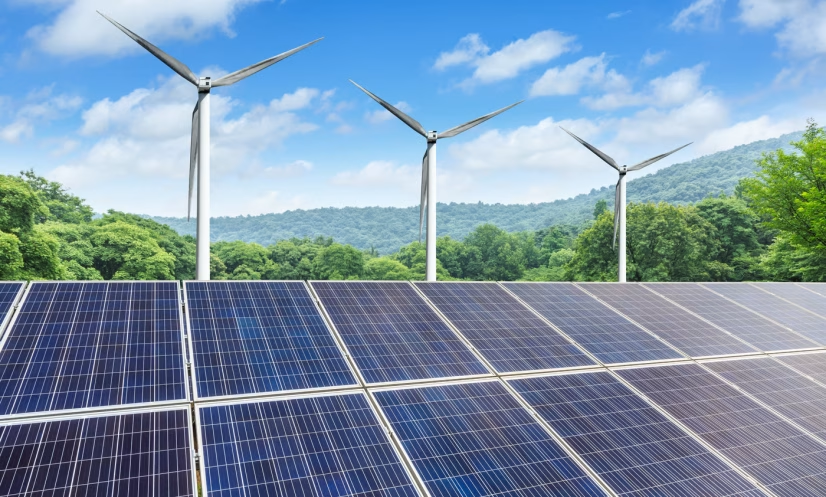
The government has set a target to meet 20 percent of the country’s electricity demand from renewable energy sources by 2030 and 30 percent by 2040 as part of its strategy to ensure a reliable, sustainable and cleaner power supply.
Power, Energy and Mineral Resources Minister Iqbal Hassan Mahmood disclosed the targets while replying to a question in Parliament on Wednesday.
He said the government has also set a long-term goal of generating 10,000 MW of electricity from solar power.
According to the minister, the country’s daily electricity demand currently ranges between 16,500 MW and 17,500 MW, while average daily power generation and supply to the national grid stands between 15,500 MW and 17,200 MW.
“On May 20, 2026, Bangladesh recorded its highest-ever electricity generation of 17,200 MW,” Mahmood said.
Highlighting government initiatives to ensure uninterrupted electricity supply, the minister said rooftop solar systems are being installed on government offices, educational institutions and healthcare facilities under the National Rooftop Solar Programme.
He said the government is also modernising power generation, transmission and distribution infrastructure to improve the quality, efficiency and reliability of electricity services.
To reduce electricity wastage and illegal consumption, prepaid electricity meters are being installed across the country, while ageing distribution lines and substations are being upgraded alongside the construction of new transmission and distribution facilities.
The minister added that efforts are also underway to reduce system losses in electricity distribution.
Responding to a separate question on electricity supply in Keshabpur under the Jashore-6 constituency, Mahmood said the upazila has a demand of 22 MW, against which 19 MW is currently being supplied.
He said Keshabpur receives electricity from both the Nowapara and Jashore grid stations under the Bangladesh Rural Electrification Board’s Jashore Palli Bidyut Samity-2.