


 Play store

By Rashedul Islam, District Correspondent
NILPHAMARI, Bangladesh — What began as a struggle to support her family after losing her husband has grown into an inspiring story of determination and innovation. Khadija Begum, a resident of Kaimari village in Jaldhaka upazila of Nilphamari, has emerged as one of Bangladesh’s successful women agricultural entrepreneurs through the cultivation, processing and marketing of coffee and a wide range of exotic fruits.
Her remarkable achievements in agriculture have earned her the Joyeeta Award and a National Award, while the Nilphamari district administration has nominated her for the prestigious Begum Rokeya Medal.
Located about 35 kilometres from Nilphamari district headquarters, Khadija’s journey began in 2014 after the death of her husband. Left to raise her two sons alone, she took charge of both the family business and farming activities.
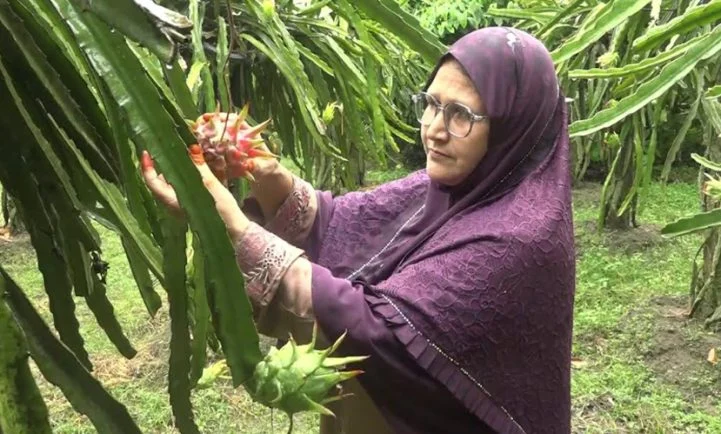
Encouraged by her elder son, she transformed a neglected piece of land behind their house into a modern fruit orchard in 2018. She initially planted dragon fruit, rambutan and avocado before expanding into other exotic crops.
A year later, she introduced around 650 coffee plants to the orchard. When the trees started bearing fruit within two years, the Department of Agricultural Extension took notice of her success and provided improved coffee seedlings along with coffee processing equipment.
Today, Khadija earns a steady income by selling coffee, exotic fruits and saplings through both online and offline markets.
She believes agriculture offers a promising future for rural women and educated unemployed youth.
“After my husband passed away in 2014, I had to shoulder the responsibility of raising my two sons and managing the family business,” Khadija said. “Alongside household responsibilities, I looked after the orchard and workers. My son suggested turning the abandoned land beside our house into a fruit garden, and in 2018 we began with dragon fruit, rambutan and avocado.”
She later shifted her focus to coffee cultivation.
“From our first 680 coffee trees, we harvested about 10 kilograms of coffee. Seeing the results, the agriculture department supplied us with improved coffee varieties. Although dragon fruit prices have fallen due to increased production, we continue producing safe and fresh fruits,” she said.
Khadija also found exceptional success with rambutan.
“I planted 20 rambutan saplings, but eight did not survive. Last season, the remaining five fruit-bearing trees alone generated around Tk 350,000 in sales. Coffee is also providing a good source of income,” she added.
Her son, Shefayet Nashrat Nayan, credits his mother’s hard work for the farm’s success.
“With my mother’s dedication, our orchard has grown significantly. We are cultivating several uncommon exotic fruits, and I have been able to apply my agricultural education in a practical way. People from different parts of the country now order saplings from us, but the greatest credit goes to my mother,” he said.
Khadija received the Joyeeta Award in 2022 for her achievements in coffee, rambutan and cocoa cultivation. In the same year, she also won a National Award for fish farming and received certification as a safe food producer.
Nilphamari Deputy Commissioner Nayiruzzaman praised her contribution to diversified agriculture.
“She has set an outstanding example as a woman entrepreneur by successfully cultivating non-traditional exotic fruits. We have provided her with a coffee processing machine and facilitated access to low-interest bank loans. We have also nominated her for the Begum Rokeya Medal,” he said.
Khadija’s three-acre orchard now features 24 varieties of exotic fruits and crops, including nearly 3,000 coffee trees. Through resilience, innovation and perseverance, she has become not only a successful entrepreneur but also a model for alternative agriculture in northern Bangladesh.