Play store

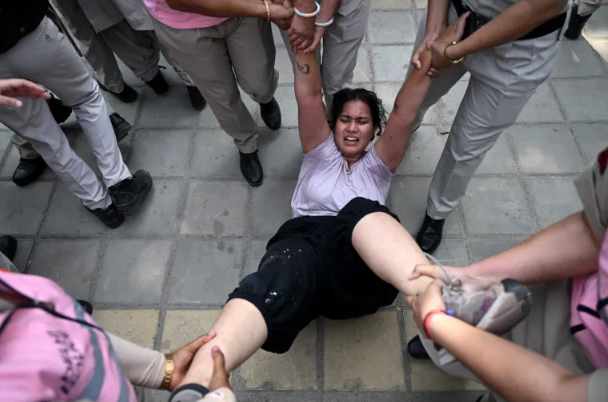
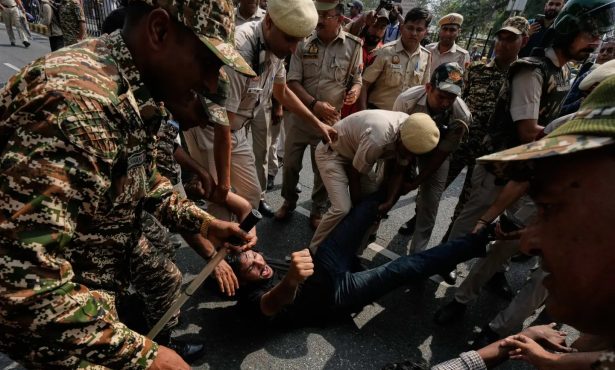
Indian police detained more than 1,000 protesters, opposition politicians, journalists, student leaders and activists in New Delhi on Saturday as authorities moved to prevent a demonstration demanding the resignation of Chief Election Commissioner Gyanesh Kumar over alleged voter roll irregularities.
The protest was organised by the satirical Cockroach Janta Party (CJP) and other youth groups to oppose the Election Commission’s Special Intensive Revision (SIR) of electoral rolls. The protesters accuse the ruling Bharatiya Janata Party (BJP) of manipulating voter lists to influence election outcomes, allegations denied by the government and the commission.
The planned demonstration was to bring thousands of people to Jantar Mantar, a designated protest site in central Delhi. However, security forces sealed off the area before the rally could begin.
Thousands of police and paramilitary personnel were deployed across the capital. Reports said train services to New Delhi were cancelled, mobile internet services suspended, and some metro stations and markets shut as authorities tightened security to prevent demonstrations.
BJP spokesperson Sambit Patra dismissed the protesters as “anarchic elements”.
“Their flop show has been completely demolished,” Patra said, adding that the scenes at Jantar Mantar did not represent the wider country.
“India is calm and going ahead under good governance,” he told reporters.
Police detained CJP founder Abhijeet Dipke and his associates Saurav Das and Ashutosh Ranka aboard an Air India flight after they arrived in New Delhi from Mumbai.
In a video posted on Instagram, Dipke showed police officers entering the aircraft after it landed. As they approached him, he said: “I have come to get arrested. I am not afraid of you guys.”
In another video shared by Ranka, Dipke was seen addressing fellow passengers before his detention.
“It was nice to know you all. We can see where the nation is heading,” he said, describing the police action as an example of dictatorship.
Police also detained other CJP members, YouTuber and Modi critic Dhruv Rathee, Neha Bora, national president of the All India Students’ Association, Communist Party of India (Marxist-Leninist) general secretary Dipankar Bhattacharya, senior Supreme Court lawyer Prashant Bhushan, and politicians Yogendra Yadav and Mamata Banerjee, according to reports.
Despite the detention of the movement’s leading figures, small demonstrations took place in other parts of the capital, including near the popular crafts market Dilli Haat.
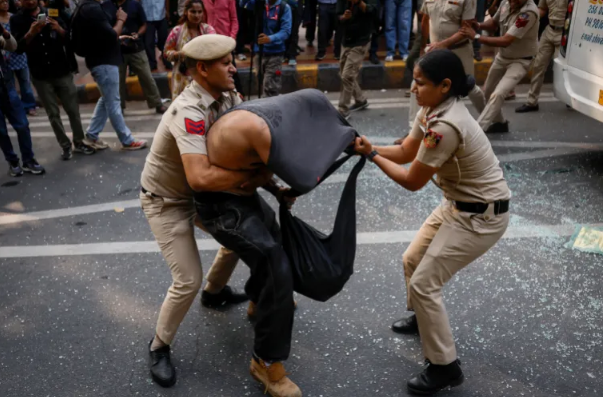
Security personnel detain a protester in New Delhi, India, October 10. Photo collected
Journalists attempting to cover the protests and people seeking to demonstrate elsewhere in the city were also detained and taken away in police buses.
Shranaya, a state committee member of the left-wing Students’ Federation of India who uses only her first name, told Al Jazeera that their New Delhi office had been under surveillance for hours. Some members managed to leave the premises and join the protests.
“This is dictatorship live and in front of us, just to protect a bureaucrat who steals elections for the BJP on Modi’s behest. They are murdering democracy in the daylight in the Indian capital,” she said.
She vowed that the protests would continue despite the arrests.
“This government is unaware of the power of the people, and that is our upper hand. We do not have weapons, but we have zeal. We will be again on the streets, and we will keep returning,” she said.
“We are students. We are unemployed. We are ‘cockroaches’ – and we will return.”
Shranaya later climbed a barricade but was dragged away by police and taken away in a bus.
Congress president Mallikarjun Kharge criticised Prime Minister Narendra Modi’s government over the mass detentions.
“Modi government has turned the ‘Mother of Democracy’ into a ‘Muzzled Democracy’!” he wrote on X.
He added that detentions, arrests, imprisonment and the use of force would not deter people, noting that young people had played a leading role in India’s freedom struggle.
The protests centre on allegations that the SIR process has removed eligible voters from electoral rolls and could have affected the outcomes of recent state elections. Opposition parties have accused the Election Commission of implementing the revision in a manner that benefits the BJP. The government and the commission reject claims of political manipulation, saying the exercise aims to remove duplicate and ineligible entries.
The controversy has intensified scrutiny of the election authorities ahead of a series of important state elections beginning in early 2027.
Amnesty International warned that the detentions reflected efforts to suppress critical voices and called for the release of those detained solely for exercising their rights to freedom of expression and peaceful assembly.
“The authorities must immediately and unconditionally release all those who have been detained solely for exercising their right to Freedom of Expression and Right to peaceful assembly,” Aakar Patel, chair of the board of Amnesty International India, told Al Jazeera.
The Committee to Protect Journalists also urged Delhi Police to respect press freedom and release detained journalists and media workers.
Kunal Majumder, the organisation’s Asia-Pacific programme coordinator, called on police to allow journalists to cover the demonstrations and the authorities’ response without interference.
The crackdown has added to political pressure on Modi’s government amid mounting controversy over the voter roll revision.
Sanjay Kapoor, editor of Hard News magazine and a political analyst, told Al Jazeera that the government’s response appeared unusually fearful of the protesters.
“The truth is that the BJP and the centre have been very, very scared of how it will all play out,” he said.
Kapoor argued that the protests reflected growing opposition to the BJP’s continued rule and suggested that the party was concerned about a shift in public sentiment.
“Modi’s government has begun to lose a lot of credibility at the moment,” he said, adding that the BJP feared it could struggle to return to power if the political ground continued to shift against it. Source: Al Jazeera News