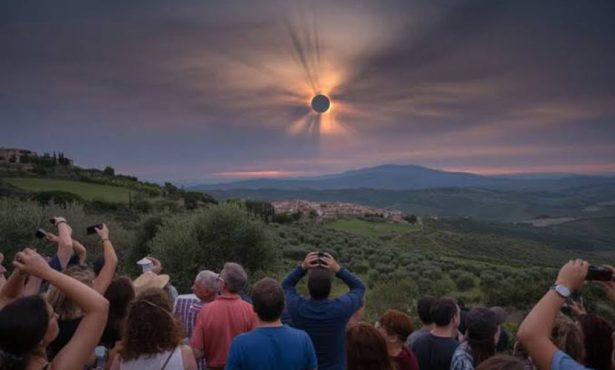
Play store

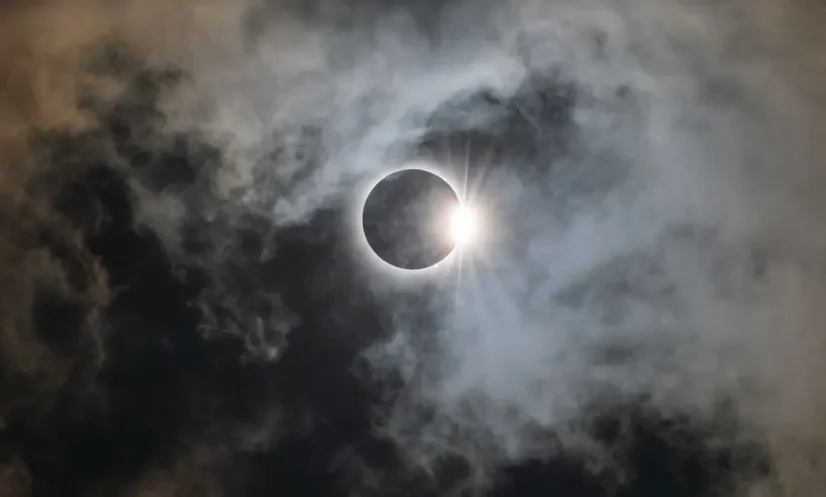
A total solar eclipse will create a celestial spectacle in the sky for the first time in more than two years on August 12.
A total solar eclipse happens when the moon passes between the sun and Earth, casting a shadow on our planet that fully blocks the sun’s light from some areas of the world, according to NASA.
Sky-gazers in parts of Greenland, Iceland, northern Spain and northeastern Portugal will glimpse totality, when the skies go momentarily dark as the sun completely disappears.
Meanwhile, a partial eclipse, in which only some of the sun’s light is blocked from view, will be seen across parts of Europe, Africa and North America.
A total solar eclipse was visible from Mexico, the United States and Canada in April 2024, but the last one observable from mainland Europe occurred in 2006, according to the European Space Agency.
The August event is the first total solar eclipse that will be visible from Spain’s mainland since 1905 — and it’s the first of three solar eclipses the country will witness between now and 2028, according to the ESA.
“A total solar eclipse is one of those rare moments when millions of people can look up together and feel both wonder and curiosity,” Carole Mundell, the ESA’s director of science, said in a statement. “It is a shared moment that connects us to the Universe and reminds us that the desire to explore and understand is one of humanity’s greatest strengths.”
The narrow path of totality will span 5,157 miles (8,300 kilometers), starting over the Arctic coastline at around 1 p.m. ET and then passing near the North Pole before moving over Greenland, Iceland, Portugal and northern Spain, according to EarthSky.
Eclipse watchers in Greenland should see just over two minutes of totality, while those in northern Spain may only see about 20 seconds — conditions permitting. Inclement weather is always the greatest obstacle to eclipse viewing.
The eclipse will pass over Galicia and then the Balearic Islands in Spain as sunset approaches, hastening the transition from day to night, according to the Spanish Scientific and Advisory Committee for the Trio of Eclipses.
To check when the eclipse will occur in your area, and what it will look like, check Time and Date’s website.
For those who live outside the eclipse’s path, the ESA will share a livestream of totality from Spain’s Astrophysical Observatory of Javalambre in Teruel.
The next total solar eclipse will pass over southern Spain, North Africa, Saudi Arabia and Yemen on August 2, 2027, according to NASA.
The United States won’t have an opportunity to glimpse a total solar eclipse again until March 30, 2033, and even then, the only vantage point will be in Alaska.
It won’t be until August 22, 2044, that a total solar eclipse will be visible from the contiguous United States, when totality will occur over North Dakota and Montana.
The next total solar eclipse with a coast-to-coast path spanning the Lower 48 states will take place on August 12, 2045.
The path of totality will arc over California, Nevada, Utah, Colorado, Kansas, Oklahoma, Arkansas, Mississippi, Alabama and Florida, with a partial eclipse visible across other states.