Play store

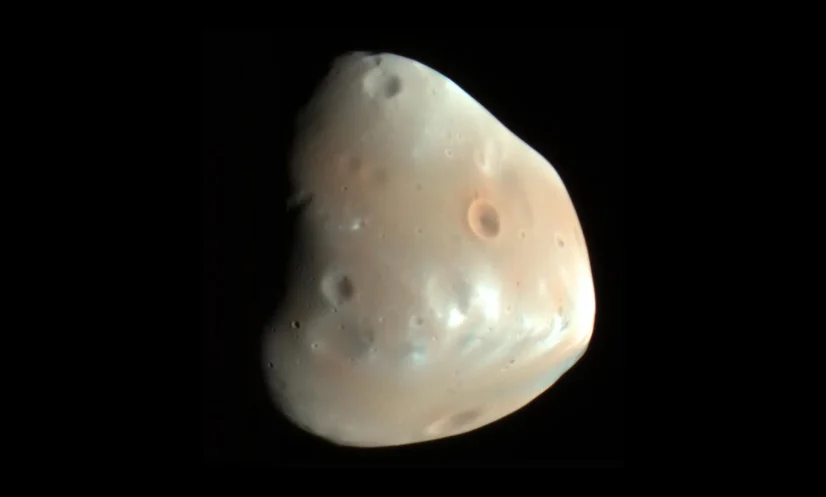
An international team led by the University of Bern has found evidence that a single asteroid impact may have dramatically reshaped Deimos, the smaller and more distant of Mars’ two moons.
By combining high-resolution computer simulations with observations from the European Space Agency’s Hera spacecraft, researchers concluded that one powerful collision could explain both Deimos’ large southern depression and its unusually smooth, dusty surface.
The study, published in Nature Astronomy, is the first scientific research to incorporate observations collected during Hera’s flyby of Deimos.
Deimos has a roughly oval shape and a prominent depression near its south pole. Unlike Phobos, Mars’ other moon, it appears relatively smooth because much of its surface is covered by loose dust and rocky debris known as regolith.
Scientists had previously been uncertain about the origins of both the southern depression and the extensive debris covering the moon.
A new study led by Sabina Raducan examined whether the two features could have been created by the same event. The international team included researchers from the Observatoire de la Côte d’Azur, the University of Arizona and the University of Tokyo.
Using high-resolution simulations generated with the Bern Smoothed Particle Hydrodynamics (SPH) code, the researchers found that an asteroid impact powerful enough to create the southern depression could also have produced large quantities of debris without destroying Deimos.
The team ran around 100 simulations, varying the asteroid’s size, speed and impact angle, as well as assumptions about Deimos’ internal structure. Each simulation took about a week on a high-performance computing cluster at the University of Bern.
The results were then compared with observations collected by Hera during its flyby of Deimos.
Developed at the University of Bern over about two decades, the SPH code is designed to model major collisions involving asteroids, comets and planets. The same modelling approach was previously used to simulate NASA’s DART spacecraft impact on Dimorphos.
Hera is currently travelling toward Dimorphos, the asteroid moon targeted by NASA’s DART mission. Its observations are intended to help scientists better understand asteroid deflection and assess the feasibility of using such technology as a planetary defence measure.
The findings on Deimos could also provide valuable guidance for future missions, including the Japan Aerospace Exploration Agency’s Martian Moons eXploration (MMX) mission, which aims to study Mars’ moons in greater detail.