


 Play store

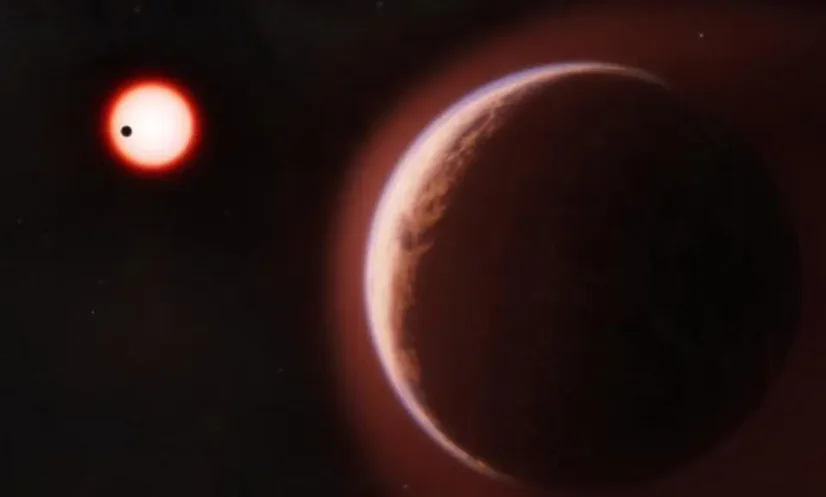
Astronomers have, for the first time, confirmed the presence of an atmosphere around a rocky planet located in the habitable zone of another star, marking a major breakthrough in the search for life beyond the solar system.
The planet, known as LHS 1140 b, lies about 48 light-years from Earth and has revealed its atmosphere through helium slowly escaping into space. The discovery provides the strongest evidence yet that a rocky planet with Earth-like temperatures can retain an atmosphere for billions of years—an essential ingredient for supporting life.
The findings, published in the journal Science on July 16, are based on observations of helium leaking from the planet’s atmosphere, confirming long-standing predictions that LHS 1140 b is enveloped by a gaseous layer.
“This is the first time anyone has found an atmosphere on a rocky planet in the habitable zone of another star,” said lead author Collin Cherubim, who recently earned a Ph.D. in Earth and Planetary Sciences from Harvard University.
“An atmosphere is essential for a planet to support life as we know it,” he added.
LHS 1140 b orbits a cool red dwarf star within its habitable zone—the region around a star where temperatures could allow liquid water to exist on a planet’s surface. The presence of liquid water is considered one of the key requirements for life.
Scientists believe the planet’s atmosphere may have survived for billions of years despite constant exposure to radiation from its host star, making it one of the most promising candidates for future studies of potentially habitable worlds.
Astronomers have discovered thousands of exoplanets in recent decades, including many rocky planets orbiting within the habitable zones of their stars. However, determining whether these distant worlds possess atmospheres has remained one of the greatest challenges in exoplanet research.
The detection of helium escaping from LHS 1140 b provides the clearest evidence yet that at least some rocky exoplanets can maintain atmospheres over long periods.
Researchers say the discovery opens a new chapter in the search for Earth-like planets and could help scientists identify worlds capable of supporting life.
Future observations with powerful space telescopes are expected to study the atmosphere in greater detail, searching for water vapour, carbon dioxide and other gases that could offer further clues about the planet’s environment and its potential habitability.
Astronomers describe LHS 1140 b as one of the most promising targets for future investigations aimed at finding signs of life beyond Earth.