Play store

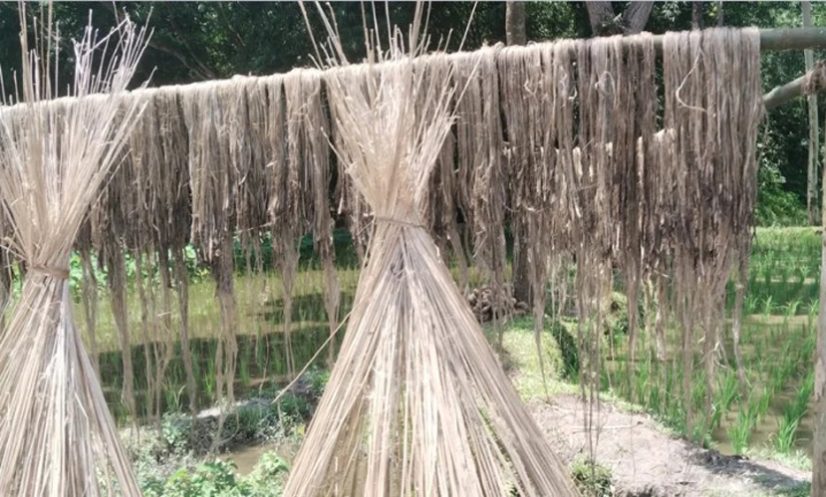
Jute was once deeply intertwined with the rural economy of Nilphamari. Known as the “golden fibre”, the crop was a major cash earner for farmers, while jute harvesting, retting, fibre extraction, drying and marketing created additional economic activity across rural communities during the monsoon.
But that familiar agricultural landscape is changing. Rising production costs, labour shortages and a lack of suitable water for retting have prompted many farmers to move away from jute cultivation.
At the same time, corn is becoming increasingly attractive because it requires less time to harvest, involves less labour-intensive processing and has strong market demand. As a result, corn is replacing jute on farmland in several parts of Nilphamari.
The shift reflects more than a change from one crop to another. It highlights the changing calculation of profit and risk among farmers in the northern region.
A visit to different parts of the district found far fewer jute fields than in previous years, while large areas of farmland were being used to grow corn. In many cases, farmers had already harvested the corn and planted rice on the same land.
Farmers said crop selection is no longer based simply on tradition. They now consider production costs, cultivation time, labour requirements, market prices and the certainty of sales before deciding what to grow.
Farmer Jalil Mia said jute cultivation had declined mainly because of difficulties with retting.
“After harvesting jute, the stalks have to be kept underwater for a long time to separate the fibre. But in many areas, suitable deep and clean water is not available. Farmers sometimes have to transport the jute to distant water bodies or arrange artificial retting facilities,” he said.
Another farmer, Arbindu Roy, said jute cultivation had become increasingly risky.
“Jute cultivation can result in losses. If heavy rain suddenly leaves waterlogged conditions in the field, the crop may stop growing properly. In a word, the weather has become unpredictable,” he said.
He said the cost of cultivating jute had also increased because almost every stage requires labour.
“Jute requires workers for cutting, bundling, carrying, retting, stripping the fibre, washing and drying. As labour wages have risen, the cost of all these activities has also increased,” he said.
Farmers said that even when jute prices are favourable, higher labour costs, adverse weather and lower yields can create the risk of losses if they fail to receive the expected market price. Many are therefore turning to crops they consider less risky.
According to farmers, one of the biggest advantages of corn is that it can be harvested in a relatively short period. Unlike jute, it does not require retting, fibre extraction or lengthy processing.
Corn is also easier to dry, store and transport. Its strong demand for animal feed and poultry feed means farmers can generally find buyers in local markets.
Farmers said corn can provide a quicker return when yields and prices are favourable, while harvesting it earlier also allows them to plant another crop on the same land. This has become an important factor in their decision-making.
Several farmers in Domar upazila said they used to cultivate jute regularly but now allocate a significant portion of their farmland to corn.
Farmer Jamiar Rahman said jute cultivation involved considerable uncertainty.
“Jute requires repeated weeding and fertilisation, but the biggest challenge comes during harvesting and retting. With corn, I can manage weeding and fertilisation myself, and machines are now available for processing after harvest. So there are fewer worries compared with jute,” he said.
Another farmer, Lokman Hossain, said farmers were now making cultivation decisions based primarily on profitability.
“Farmers now calculate the returns. Naturally, they are more interested in crops that take less time, keep costs under control and provide money quickly after sale,” he said.
However, some farmers with years of experience in jute cultivation said the crop could still be profitable when prices and weather conditions are favourable. But uncertainty over fair prices and market management is discouraging many from taking the risk.
Domar Upazila Agriculture Officer Rafiqul Islam said jute had been cultivated on 950 hectares in the upazila this year.
“Jute prices are reasonably good this year. However, for the past two or three years, a problem has emerged across much of the country regarding jute retting,” he said.
He said unpredictable weather, including sudden rainfall, was another factor discouraging farmers.
“If you sow jute seeds and sudden rain follows, the seeds can be damaged. Problems with retting, labour shortages and other factors are also reducing farmers’ interest in jute cultivation,” he added.
The fields where jute once represented an important part of Nilphamari farmers’ economic aspirations are now increasingly filled with rows of corn.
The change is therefore more than a shift in crops. It is a reflection of the changing economic realities faced by farmers. They are increasingly choosing crops based on calculation rather than tradition or sentiment.
For jute to regain its place in farmers’ fields, reducing risks at every stage—from production to marketing—will be the biggest challenge.