Play store

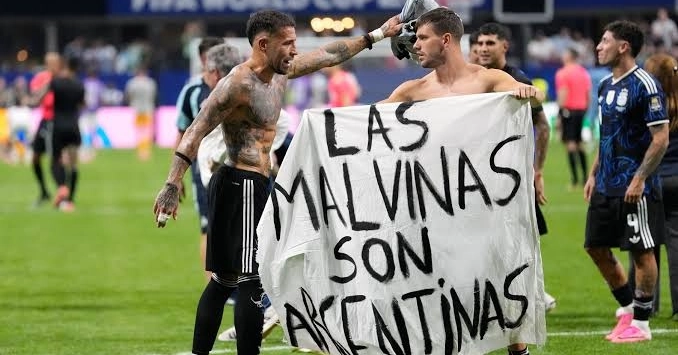
The United Kingdom has called on FIFA to investigate Argentina’s national football team after players displayed a politically charged banner referencing the disputed Falkland Islands following their World Cup semifinal victory over England.
Argentina secured a 2–1 win in Atlanta on Wednesday, but post-match celebrations drew controversy when players held up a banner reading “Las Malvinas son Argentinas” (“The Malvinas are Argentine”)—a slogan asserting Argentina’s claim over the British-controlled Falkland Islands.
UK Business Secretary Peter Kyle condemned the move as “entirely inappropriate” and urged football’s governing body to take action. Under FIFA’s disciplinary rules, political, ideological, or offensive messages are prohibited at official events, with potential fines ranging from $5,000 to $20,000.
FIFA had not issued an official response as of Thursday.
Despite the criticism, Argentine players defended the gesture, describing it as an emotional expression tied to national history.
Defender Lisandro Martínez said the message could resonate deeply with veterans of the 1982 Falklands War, while midfielder Leandro Paredes called it a reflection of a painful chapter that still affects many Argentines.
The Falkland Islands—known as Islas Malvinas in Argentina—remain a sensitive geopolitical issue. The islands, a British Overseas Territory with a population of about 3,500, lie roughly 480 kilometres off Argentina’s coast.
Tensions date back centuries but escalated in 1982 when Argentina invaded the islands, triggering a 10-week war. Britain ultimately regained control, with the conflict claiming the lives of 649 Argentine soldiers, 255 British personnel, and three islanders.
The incident has reignited debate over FIFA’s commitment to political neutrality, particularly during major tournaments. Critics have already questioned recent disciplinary decisions, arguing that enforcement of rules has been inconsistent.
FIFA President Gianni Infantino is expected to attend Sunday’s World Cup final between Argentina and Spain in New Jersey, alongside several global leaders, adding further attention to the governing body’s handling of the issue.
This is not the first time Argentina has faced scrutiny over the Malvinas slogan.
In 2014, the Argentine Football Association was fined after players displayed a similar message during a pre-World Cup match.
Comparable cases have also occurred internationally, including sanctions against South Korea’s Park Jong-woo in 2012 and Serbia’s football federation during the 2022 World Cup for politically sensitive displays.
As calls for an investigation grow, the latest controversy highlights the delicate balance between national expression and FIFA’s rules on keeping politics out of football.