


 Play store

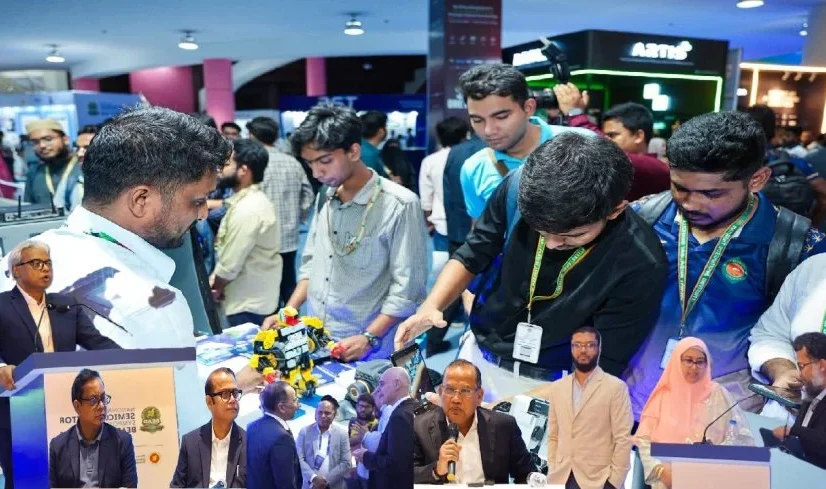
Bangladesh has adopted a strategic roadmap aimed at positioning itself not only as a user of advanced technologies but also as a leading innovator and manufacturer in the global semiconductor and frontier technology value chain.
The vision, titled “Science to Economy: Building a Market-Linked, Innovation-Driven Bangladesh,” was outlined during the closing ceremony of the two-day National Semiconductor Symposium and BEAR (Bangladesh Electronics and Advanced Research) Summit 2026, jointly organized by the Ministry of Science and Technology and the Bangladesh Semiconductor Industry Association (BSIA) at the Bangabandhu Sheikh Mujibur Rahman Novo Theatre in Dhaka.
Officials said a comprehensive national roadmap, incorporating feedback from all stakeholders, will be announced shortly following the summit.
Professor Mohammad Mostafa Hossain, the chief planner of the conference, said international collaboration is essential for achieving technological advancement. He revealed that discussions have made significant progress with global semiconductor industry leaders, including Synopsys, GlobalFoundries and SanDisk, on potential partnerships. Talks are also underway to establish an Advanced Packaging Research Center in Bangladesh to strengthen the country’s semiconductor ecosystem.
“The final roadmap will be released soon after consolidating recommendations and feedback from all stakeholders,” he said.
Speaking at the closing ceremony, Science and Technology Secretary Md Anwar Hossain said the ministry has adopted a four-pillar strategy to transform scientific research into economic value by linking innovation directly with market demand.
The strategy focuses on developing a strong STEM talent pipeline, facilitating the transfer of research to the marketplace (R2M), promoting innovation-to-market (I2M) initiatives, and prioritizing frontier technologies to enhance the country’s competitiveness.
He also announced that plans are underway to establish a National Biotech Park and a National AI Institute as part of the government’s broader efforts to strengthen research, innovation and technology-based industries.
BSIA President M A Jabbar said the government is working to provide policy support aimed at attracting both local and foreign investment in semiconductor design, testing and advanced packaging.
He said Bangladesh has significant potential to become an important destination for semiconductor-related services by developing skilled human resources and creating a supportive investment environment.
The two-day summit featured six panel discussions involving 46 experts, engineers, young innovators and investors from home and abroad. Participants exchanged views on emerging technologies, semiconductor manufacturing, research collaboration, workforce development and investment opportunities.
The symposium is part of Bangladesh’s broader strategy to build a knowledge-based economy and strengthen its position in high-value global technology industries. Officials expressed optimism that closer collaboration with international technology companies and investment in research infrastructure would enable the country to gradually integrate into the global semiconductor supply chain.
The government believes the initiative will help accelerate technological innovation, create high-skilled employment opportunities and contribute to sustainable economic growth by expanding Bangladesh’s presence in one of the world’s fastest-growing high-tech industries.