Play store

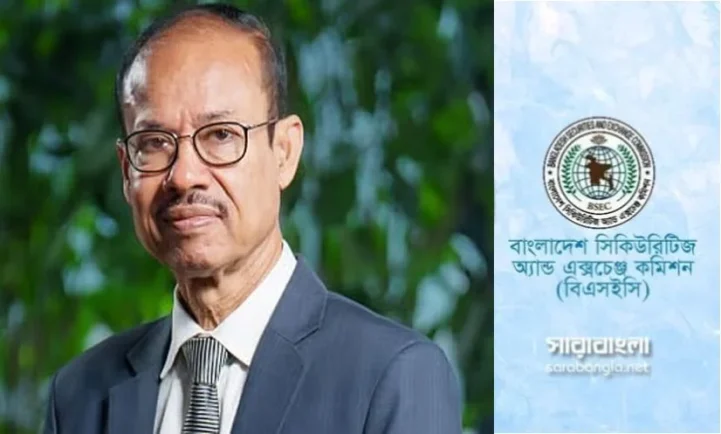
Bangladesh Securities and Exchange Commission (BSEC) Chairman Masud Khan on Saturday announced a series of technology-driven reforms, including the full digitalisation of investors’ signature verification process and the introduction of an AI-based market surveillance system, to curb irregularities in the capital market and restore investor confidence.
Speaking as the chief guest at a shadow parliament debate titled “Measures to Restore Confidence in the Capital Market” at the Bangladesh Film Development Corporation (BFDC), Masud said the reforms would strengthen market oversight and prevent manipulation.
He said the Dhaka Stock Exchange (DSE) is developing a special back-office software system that will prevent brokerage houses from altering clients’ information without authorisation by making the investor signature process fully digital.
“We have instructed the DSE to make its surveillance division AI-based within the next year. Once implemented, manipulators will no longer be able to artificially inflate weak stocks. If the price of any share rises abnormally, trading in that stock will be suspended automatically,” he said.
Masud described rebuilding the capital market and restoring investor confidence as an achievable task.
“Many people asked me why I accepted such a difficult responsibility. I told them I wanted to see whether I could bring about change. Now I can say it is not as difficult as many think. The market will recover through the measures we are taking,” he added.
The BSEC chairman also pledged stricter supervision of brokerage houses and said the commission was revising the margin rules introduced last year, which he said had discouraged investors.
He noted that retail investors have been the dominant participants in Bangladesh’s capital market for the past four decades, but many lack adequate market knowledge and often invest in fundamentally weak stocks based on rumours in the hope of making quick profits.
To improve investment decisions, he stressed the need to strengthen the mutual fund industry, citing India as an example where mutual funds account for a significant share of market capitalisation.
Masud also said regulatory decisions would be taken in the broader interest of the market rather than for the benefit of any individual or group.
Criticising the practice of organising overseas roadshows to attract foreign investors, he said international investors would come naturally if Bangladesh ensured a stable market environment.
“There is no point in holding roadshows if the market is constrained by measures such as floor prices or if there is instability in the foreign exchange market. We must resolve these structural issues first,” he said.
Referring to the ongoing merger of five troubled banks, Masud said the process falls primarily under the jurisdiction of Bangladesh Bank. While acknowledging that shareholders of the affected banks are likely to suffer losses, he said any decision regarding their interests should be taken jointly by the government and the central bank.
The debate competition, organised by Debate for Democracy, focused on the causes of the confidence crisis in the capital market. Participants representing the government side argued that weak regulatory institutions were primarily responsible, while the opposition side blamed the lack of political will. The proposition highlighting weak regulatory institutions was adopted by a one-point margin.
Students from Prime University represented the government side, while Sonargaon University participated as the opposition. The event was chaired by Debate for Democracy Chairman Hasan Ahmed Chowdhury.