


 Play store

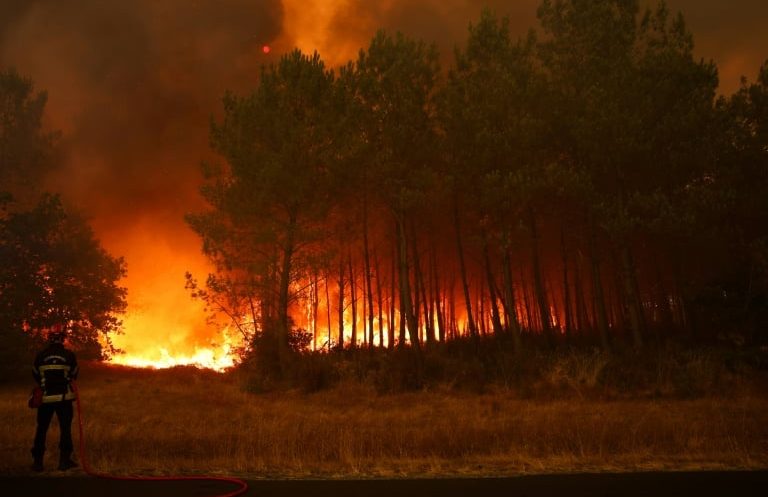
Deadly wildfires fuelled by extreme heat, dry conditions and strong winds continued to rage across southern Europe, forcing tens of thousands of people to evacuate their homes and holiday resorts as firefighters struggled to bring the blazes under control.
The fires have swept through parts of France, Italy and Spain, killing at least three firefighters and destroying homes, forests and critical infrastructure as temperatures climbed above 40 degrees Celsius in several areas.
According to the European Forest Fire Information System (EFFIS), the total area burned across European Union member states so far this year is already the second highest on record, underscoring the growing impact of increasingly severe wildfire seasons.
France has requested emergency assistance from the European Union after fast-moving fires overwhelmed local firefighting resources.
President Emmanuel Macron said France had activated the EU Civil Protection Mechanism, requesting six additional firefighting aircraft to reinforce efforts in the country’s hardest-hit regions.
More than 20,000 people, many of them tourists staying in campsites and holiday accommodation, have been evacuated from the Atlantic coast near Bordeaux since Wednesday as a massive wildfire tore through coastal pine forests.
Firefighters managed to contain the northern edge of the blaze, but flames continued advancing southward, forcing emergency crews to defend homes street by street around the popular tourist destination of Lège-Cap-Ferret.
In southeastern France, dozens of additional wildfires have erupted around the historic village of Cotignac, where officials said around 25 homes have been destroyed since Tuesday.
“The gendarmes came and knocked on every door. The fire was about 500 metres away. We grabbed some belongings and left,” said Patrick Martineau, a resident of Le Porge, one of the evacuated communities.
The latest disaster comes just three years after devastating fires in the same region forced around 50,000 people to flee.
Italy is also facing an intense wildfire emergency, with hundreds of firefighters deployed across Sicily and the southern region of Calabria.
One firefighter died after falling ill while battling flames in Sicily, according to Italy’s Interior Ministry.
Authorities in Calabria are also investigating suspected arson attacks. A regional official alleged that some fires were deliberately spread by attaching flammable materials to stray animals, though investigations remain ongoing.
In neighbouring Spain, authorities ordered approximately 3,500 residents of the town of Aldea de Fresno, west of Madrid, to evacuate late Thursday as an out-of-control forest fire approached residential areas.
Emergency alerts were sent directly to residents’ mobile phones as firefighters, supported by specialist military units and aircraft, worked through the night to contain the blaze.
Another major wildfire continues to burn in Guadalajara province, north of Madrid, where hundreds of firefighters remain on the front lines despite improving conditions.
Earlier this week, another wildfire near Toledo forced the evacuation of several villages before firefighters succeeded in bringing it under control.
Experts say climate change is making European wildfire seasons longer, hotter and more destructive.
A new study by the World Weather Attribution group concluded that human-induced climate change, driven largely by the burning of fossil fuels, has intensified drought conditions across Europe, making forests far more susceptible to large and fast-moving fires.
Spanish Civil Protection chief Virginia Barcones warned that some wildfires have become so intense that emergency crews have little chance of stopping them under extreme weather conditions.
“Climate change is what kills, what destroys our villages and our natural and cultural heritage,” she said.
She added that although conditions in Guadalajara had improved, strong winds, exceptionally high temperatures and dry vegetation continued to pose a serious threat across much of southern Europe.
Meteorologists warn that with hot and dry weather forecast to persist, the risk of further large-scale wildfires across the Mediterranean region remains exceptionally high in the coming days.